What Makes a Cooler Actually Work in Texas Heat
Before getting to the picks, here’s what separates a cooler that lasts four days in a Texas summer from one that’s done by lunch. Rotomolded construction is the key upgrade. Budget coolers are injection-molded — two pieces of plastic snapped together with a seam. Rotomolded coolers are cast as a single piece of polyethylene, which eliminates heat-conducting seams and allows for 2–3 inches of insulation in the walls and lid. The difference in real-world ice retention in Texas heat is not subtle — it’s the difference between one day and five. Lid gasket — A freezer-grade rubber gasket around the lid seal traps cold air inside and keeps warm air out every time you open the cooler. Budget coolers have no gasket. Premium coolers do. In 95-degree humidity, that gasket earns its keep every hour. Insulation thickness — Budget coolers typically have about 1.5 inches of insulation. Quality rotomolded coolers have 2–3 inches. More insulation means more thermal resistance between your ice and the Southeast Texas sun. Color — White and lighter colored coolers reflect more sunlight than dark ones. In direct Texas sun, cooler color is not a small variable.The Best Camping Coolers for Texas Heat — Our Picks
Best Overall: YETI Tundra 45
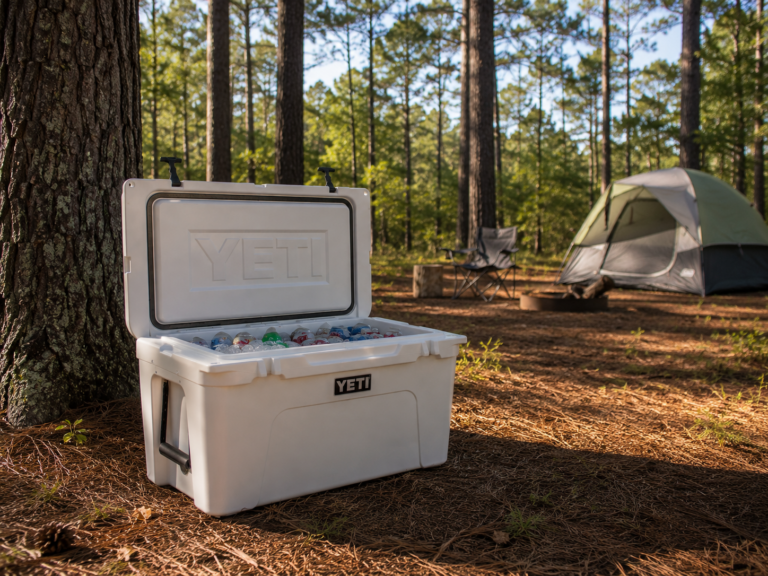
Here’s what’s worth knowing about the YETI Tundra 45 before you spend $300 on it: it works exactly as advertised, it will last longer than you expect any single piece of camping gear to last, and it’s made by a company founded in Austin, Texas — which means it was designed with our climate in mind from the start. The Tundra is rotomolded polyethylene with up to 3 inches of PermaFrost pressure-injected polyurethane insulation and a freezer-grade lid gasket. In independent testing by CleverHiker, it kept ice for 9 days and held below 40°F for 11 days. Real-world camping use in 80–90 degree temperatures puts that number at 5–7 days with normal use — more than enough for a weekend trip or a week-long fishing expedition. One thing to know: YETI’s model numbering is not volume. The Tundra 45 holds approximately 37.6 quarts, not 45. If you need true 45-quart capacity, size up to the Tundra 65 or consider the RTIC below. What you’re paying for beyond ice retention: the single-piece construction means no failure points, the rubber T-latches stay secure in rough use, and the 5-year warranty is genuine. I’ve seen YETI Tundras take serious abuse on fishing boats and tailgates and come out the other side. The $300 price is real, but the cooler is also a one-time purchase if you take care of it. Available at: Amazon | REI | Dick’s Sporting Goods Capacity: 37.6 quarts (actual) | Weight: 25 lbs | Warranty: 5 yearsBest Value Rotomolded: RTIC 45 Ultra-Tough
RTIC was founded in Cypress, Texas — just outside of Houston — and it’s been the go-to “YETI alternative” for SETX campers since it launched. The backstory: YETI sued RTIC in 2017 for producing coolers too similar to the Tundra line, and RTIC settled and redesigned. What remained is a rotomolded cooler with 3 inches of foam insulation, a tight-fitting lid, rubber latches, and nearly identical ice retention — at about 30% less than the YETI price. The practical differences: The RTIC 45 actually holds 45 quarts (true to its name, unlike YETI’s numbering). It has two drain plugs to YETI’s one — a real advantage when draining meltwater in camp. Real-world testing puts ice retention at 4–10 days depending on conditions, and independent side-by-side tests have found no meaningful performance difference between the RTIC and the Tundra in standard camping use. Where YETI wins: build quality feels slightly more refined, warranty is better (5 years vs. 1 year for RTIC), and resale value is stronger. Where RTIC wins: more actual interior space, two drain plugs, and roughly $80–100 less out of pocket. For budget-conscious SETX campers who want rotomolded performance without the premium price tag, the RTIC 45 is the honest recommendation. Available at: Amazon | RTIC direct Capacity: 45 quarts | Weight: 27 lbs | Warranty: 1 yearBest Mid-Range: Canyon Coolers Outfitter 55 V2
Canyon Coolers is less well-known than YETI and RTIC but shows up consistently at the top of independent lab testing. OutdoorGearLab named it their top pick after testing 24 coolers, and the reason is the construction: it’s rotomolded from the same type of plastic used in kayak manufacturing, which gives it a uniquely grippy, rugged exterior and walls that feel genuinely different from standard rotomolded plastic. In OutdoorGearLab’s standardized insulation testing, the Outfitter 55 held below 40°F for 5.2 days — comparable to the YETI and RTIC — while also scoring the best interior temperature in GearJunkie’s 24-hour test at 25°F (one degree colder than the YETI Roadie). It’s IGBC bear-resistant certified. The latches are a design standout — unlike anything on a competing cooler. At $300 it’s priced alongside the YETI Tundra, but the 55-quart true capacity gives you significantly more interior space than the Tundra 45. Available at: Amazon Capacity: 55 quarts | Weight: 27.4 lbs | Warranty: Lifetime on bodyBest Budget: Coleman Xtreme 5-Day
Not every camping trip needs a $300 cooler. For a weekend trip with normal Texas temperatures, the Coleman Xtreme 5-Day gets the job done at a fraction of the price — and it’s the honest pick for anyone who isn’t ready to commit to a premium cooler yet. Here’s the real story on the Xtreme: it’s not rotomolded, it doesn’t have a gasket seal, and it has about 1.5 inches of wall insulation. In honest independent testing (OutdoorGearLab, testing without pre-chilling and without shade), it held below 40°F for 3.7 days. Under more favorable real-world conditions — pre-chilled, in shade, opened less frequently — it reliably gets campers through a long weekend. The durability is the legitimate weakness. The hinges are thin, the drain plug has a plastic-on-plastic seal that can fail over time, and the handles can bow under a heavy load. Coleman addresses some of this in the newer 316 Series if you want an upgraded Coleman build. What you get: large capacity, wheeled versions available, built-in lid cupholders, the Have-A-Seat lid rated for 250 lbs (doubles as a campsite seat), and a price point that makes it an easy first purchase. For a family doing two or three state park trips a year, it works. For a week on the water at Sam Rayburn in August, upgrade. Available at: Amazon | Walmart | Dick’s Sporting Goods Capacity: 50–62 quarts depending on model | Weight: ~15–20 lbs | Warranty: 3 yearsPremium Pick: Pelican Elite
The Pelican Elite is the cooler recommendation for anyone doing extended trips — multi-day fishing at Sam Rayburn, a week at B.A. Steinhagen, or anyone who genuinely needs their food to stay safe for a week without an ice run. Pelican offers a lifetime warranty on the cooler body — the only major cooler manufacturer that does. Expect 7–10 days of ice retention under normal camping conditions, with one commonly cited review of a 3-day trip followed by 5 more days in a garage, still with ice at day 8. The construction includes stainless steel hardware, press-and-pull latches, and built-in lid cup holders and bottle opener. Where it gives up ground to YETI: only 2.1 inches of insulation (vs. YETI’s 2–3 inches), and it’s not IGBC bear-certified in standard configurations. The lifetime warranty on the body is the differentiator that matters for anyone who plans to own and use a cooler for a decade or more. Available at: Amazon | REI Capacity: Multiple sizes | Warranty: Lifetime on body, 90 days on parts| Cooler | Ice Retention | Price | Construction | Best For |
|---|---|---|---|---|
| YETI Tundra 45 Top Pick | 5–10 days | ~$300 | Rotomolded | Overall best, long-term investment |
| RTIC 45 | 4–10 days | ~$220 | Rotomolded | YETI performance, lower price |
| Canyon Outfitter 55 V2 | 5+ days | ~$300 | Rotomolded | More capacity, lab-tested performance |
| Coleman Xtreme 5-Day Budget Pick | 3–5 days | ~$60–80 | Standard | Budget weekend trips |
| Pelican Elite | 7–10 days | ~$350+ | Rotomolded | Extended trips, lifetime warranty |
How to Make Any Cooler Last Longer in Texas Heat
The cooler you buy matters — but how you use it matters almost as much. These tips apply regardless of what you’re working with, and they make a real difference in SETX conditions. Pre-chill the cooler the night before. A warm cooler shell absorbs the cold from your ice before it ever reaches your food. Fill it with a sacrificial bag of ice or cold water the night before your trip, dump it in the morning, then pack with fresh ice. This one step can add a full day of ice retention. Keep it out of direct sun. This sounds obvious but it’s the most violated rule on every campsite. Put the cooler in the shade of a tree, under a tarp, inside your vehicle, or covered with a wet towel. Direct Texas sun on a dark cooler surface is working against you constantly. Use the 2:1 ratio. Two parts ice to one part food and drinks. Most people under-ice their cooler by half. Empty space is warm air, and warm air melts ice. Fill the cooler completely — pack ice around and between everything. Use block ice for the base, cubed ice to fill gaps. Block ice melts significantly slower than cubed ice or bagged party ice. Lay blocks at the bottom, add your food, fill gaps with cubed ice. If you don’t have blocks, freeze water jugs at home — same effect, and when they melt you have cold drinking water. Don’t drain the meltwater. Cold water insulates the remaining ice. The only reason to drain is if your contents are at risk of getting wet. Otherwise, leave it. Pack coldest items at the bottom, most-needed items on top. Every lid opening lets warm air in. The less you have to dig, the less it costs you in ice life. Pre-chill your food and drinks. Room-temperature drinks in a cold cooler are your ice’s enemy. Put drinks in the fridge or a secondary cooler the night before so everything going in is already cold.Do You Actually Need a Soft Cooler?
Soft coolers have a real role in a SETX camp kit — just not as your primary cooler. A quality soft cooler like the YETI Hopper Flip is the right move for day trips away from your main camp, fishing from a kayak, or keeping drinks accessible without opening the main cooler constantly. In independent testing in 90°F direct sun, the Hopper Flip held ice for 20+ hours — enough for a full day on the water. Don’t rely on a soft cooler as your only cooler for a multi-night SETX trip. Use it as a satellite cooler alongside your main hard-sided unit.FAQ
How long does ice last in a YETI cooler in Texas summer heat? In real-world camping use at 80–90°F with normal lid opening frequency, expect 5–7 days of ice. Under ideal conditions (pre-chilled, in shade, opened infrequently), independent testing has recorded up to 9–10 days. In direct Texas sun with heavy use, plan for 4–5 days. Is RTIC as good as YETI? For practical camping purposes in Southeast Texas, yes. Both are rotomolded with 2.8–3 inches of insulation and comparable ice retention. YETI wins on build feel, warranty (5 years vs. 1), and brand durability track record. RTIC wins on price (about $80–100 cheaper), true-to-number capacity, and two drain plugs. Most campers who’ve owned both struggle to find meaningful performance differences in real use. What size cooler do I need for a weekend camping trip? For two people on a weekend trip, a 40–50 quart cooler is the right size. For a family of four, 65–75 quarts. Remember the 2:1 ice ratio — a 45-quart cooler fills fast when two-thirds of it is ice. Most people underestimate how quickly a cooler fills up when packed correctly. Is the Coleman Xtreme worth it for Texas camping? For a two-night weekend trip with shade access and moderate temperatures, yes. It reliably gets campers through a long weekend and the price is hard to argue with. For summer camping in SETX heat, a week at a lake, or any trip where food safety over multiple days is critical, upgrade to a rotomolded cooler. What’s the best way to keep a cooler cold in Texas summer? Pre-chill the cooler the night before, keep it out of direct sun, use a 2:1 ice-to-contents ratio, pack with block ice at the bottom and cubed ice filling gaps, pre-chill all food and drinks before packing, don’t drain meltwater, and minimize lid openings. Following these steps will add 1–2 days of ice retention to any cooler regardless of price. Which cooler brand is made in Texas? Both YETI and RTIC have Texas roots. YETI was founded in Austin and manufactures some of its Tundra line in Iowa and Wisconsin. RTIC was founded in Cypress, Texas (northwest Houston). If supporting Texas companies matters to your purchase decision, either brand qualifies.For more on building out your full gear kit for camping in Southeast Texas, check out our complete Texas camping gear guide, the gear guide for beginners, and our budget camping gear picks under $50 for everything else you need before the trip. And before you head out — grab the free Ultimate Family Camping Checklist. 83 items across 7 categories, built for camping in Southeast Texas.
This post contains affiliate links. If you purchase through these links, we may earn a small commission at no extra cost to you. Thank you for supporting SETX Camping!