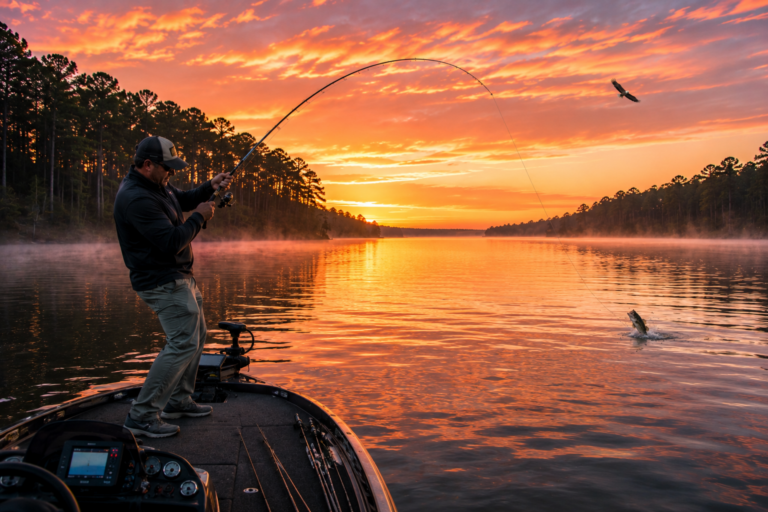
Fishing Sam Rayburn Reservoir puts you on 114,500 acres of East Texas Piney Woods water — the largest lake located entirely within Texas and the one that Bassmaster Magazine ranked as America’s best bass lake. The lake hosts over 300 fishing tournaments annually. The lake record largemouth bass is 16.80 pounds. Crappie and catfish fisheries are rated excellent year-round by TPWD. White bass run up the Angelina River in spring.
I grew up fishing Southeast Texas, and Sam Rayburn is the lake that serious SETX anglers talk about the way other people talk about other things entirely. It’s that good, and it takes real time to figure out. This guide covers what the lake is, how it fishes by species and season, the specific arms and structure worth knowing, and what gear to have on the water.
The Lake at a Glance
Sam Rayburn Reservoir was built on the Angelina River by the US Army Corps of Engineers between 1956 and 1965. The main lake runs roughly north-south, with five major arms extending east and west off the main body:
- Angelina River arm — the largest and most prominent arm, running north
- Ayish Bayou arm — major eastern arm, consistent bass and catfish production
- Black Fork arm — western arm, spring bass fishing
- Attoyac River arm — northeastern arm
- Bear Creek arm — smaller arm in the upper reservoir
Understanding which arm you’re on — and which part of that arm — is the foundation of figuring out Sam Rayburn. The upper third of the lake is murky and stained, heavily timbered, and holds fish differently than the lower lake near the dam, which runs comparatively clear and has more defined hydrilla edges, creek channel drop-offs, and deeper structure.
What holds fish on Sam Rayburn:
- Hydrilla (the predominant aquatic vegetation — massive beds throughout)
- American lotus and lily pad flats
- Standing timber — flooded when the reservoir was built, still present after 60 years
- Creek channel intersections and drop-offs
- Submerged roads and tank dams
- Brush piles (both natural and TPWD-placed)
- Rocky cliffs in the lower lake near the dam
- Bridges, laydowns, and docks
Current water level: Check usgs.gov or the Corps of Engineers Sam Rayburn Reservoir page before any trip. The lake runs significantly below pool during drought years and the fishing patterns change when the lake is down. Knowing the current level tells you whether the hydrilla beds are exposed, whether your normal boat ramp is usable, and how the fish are positioned relative to structure.
Species — What TPWD Rates and What to Expect
Largemouth Bass — Excellent, Year-Round
The reason most people come to Sam Rayburn. TPWD rates the largemouth bass fishery as excellent on a year-round basis, and that rating is earned. The lake produces consistent quality fish across all sizes — not just the occasional trophy but a genuine population of healthy fish spread throughout the system.
The lake record is 16.80 pounds. Fishing Sam Rayburn long enough, you encounter fish over 5 pounds regularly if you’re in the right areas at the right times. The lake is not without challenges — 114,500 acres is a lot of water to figure out — but the fish are there.
Special regulations apply. Check current bag and size limits at tpwd.texas.gov before fishing. Sam Rayburn has specific regulations on bass and other species that differ from standard statewide rules.
Crappie — Excellent, Year-Round
Sam Rayburn’s crappie fishery is genuinely exceptional and gets less attention than the bass program. Both black and white crappie are present in good numbers throughout the reservoir, with the man-made brush piles that TPWD has placed throughout the lake serving as reliable year-round concentration points.
Ask at local tackle shops in Jasper or Zavalla for current brush pile GPS coordinates — these spots are not secret and local tackle shop operators share them freely. A brush pile at the right depth in the right area produces crappie all year, not just during the spring spawn.
Spring spawn (March–May) moves crappie shallow — target areas around vegetation and timber in 3–6 feet of water with jigs and minnows.
Catfish — Excellent, Year-Round
Channel catfish are excellent year-round throughout the reservoir. Blue and flathead catfish are also present.
Fish consumption advisory: The Texas Department of State Health Services has an advisory in effect on Sam Rayburn Reservoir for dioxins and mercury. Species affected include blue catfish and flathead catfish, as well as gar and smallmouth buffalo. Check the current TDSHS fish consumption advisory before keeping blue or flathead catfish from this lake. Channel catfish are not on the current advisory.
White Bass (Sand Bass) — Fair, Best in Spring
White bass numbers are limited on Sam Rayburn overall, but the spring spawning runs up the Angelina River and other tributaries provide good fishing opportunities from roughly February through April. Local anglers call them sand bass — same fish, regional name — and the spring run produces some of the most consistent action on the lake for numbers of fish.
Winter schools of white bass hold in 20–40 feet of water around creek channel intersections and river bends. Use a fish finder to locate the schools, then work the depth with small jigs, blade baits, and white twister tail grubs.
Bluegill and Redear Sunfish — High Numbers
TPWD rates sunfish populations as excellent at Sam Rayburn. Bluegill and redear sunfish are abundant throughout the reservoir and are the most consistent catch for beginners, kids, and anyone who just wants to feel fish. Around vegetation, shallow timber, and creek mouth areas — crickets, worms, and small jigs all work.
Seasonal Patterns
Spring (March–May) — Best Overall Season
The best fishing season at Sam Rayburn, and the one that fills the campgrounds at Mill Creek, Twin Dikes, and Hanks Creek with tournament rigs from across Texas.
Bass: The spawn drives bass shallow. Pre-spawn fish stage on points adjacent to spawning pockets — target these with spinnerbaits, lipless crankbaits, and bladed jigs as fish move up. Spawning fish in 1–4 feet of water respond to soft plastics on Texas rigs, wacky rigs, and light jigs fished slowly. Post-spawn fish scatter briefly before moving to summer patterns.
Crappie: Move shallow around timber and vegetation during the spawn. Best shallow crappie fishing of the year — jigs and minnows around wood in 3–6 feet.
White bass: Spring run up the Angelina River. Work the river channel and creek mouths with small jigs and spinners.
Best areas in spring: Backs of pockets in Ayish Bayou, Black Fork arm coves, shallow timber in the upper lake, hydrilla edges and flats in the mid-lake.
Summer (June–August) — Early and Late Only
The hottest part of the year produces the toughest midday conditions — water temperatures in the upper lake can push into the 90s. The bite concentrates at the edges of the day.
Bass: Before sunrise and after sunset are the money windows in summer. Night fishing along submerged points, channel ledges, and timber edges produces the biggest fish of the year at Sam Rayburn during summer nights. Big worms on Texas rigs and Carolina rigs dominate the ledge bite. On hydrilla mats, hollow-body frogs worked on the surface in the early morning produce violent strikes.
Midday summer strategy: drop to deeper structure — creek channel intersections, humps in 8–14 feet, submerged roadbeds. Drop shot, finesse jigs, and shaky heads work when fish go deep.
Crappie: Brush piles in 15–25 feet hold summer crappie throughout the day. Night crappie fishing around dock lights and timber is productive.
Catfish: Night fishing is the summer catfish strategy. Creek channels and deeper holes with cut shad, chicken liver, and stinkbait on bottom rigs.
Fall (September–November) — Strong Comeback
As water temperatures drop from summer highs, bass and crappie return to more active patterns throughout the water column.
Bass: Baitfish movements are the key. Threadfin shad school up on windblown points and grass lines in fall, and bass follow them. Crankbaits, spinnerbaits, and swim jigs covering water efficiently are the fall approach. Cover water, find the bait, find the bass.
Crappie: Fall is a strong crappie period as fish move from summer depth back toward moderate depths. Timber edges in 8–15 feet, jigs in white and chartreuse.
Catfish: Strong fall catfish bite as fish feed aggressively before winter. Creek channels and main lake structure with cut bait.
Winter (December–February) — Slow, Then Building
The slowest fishing of the year by mid-January, but the pre-spawn movement begins by mid-to-late February. By late February, fish in the pockets of Ayish Bayou and the back ends of major arms are staging and beginning to scout bedding areas.
Bass: Target points adjacent to spawning pockets by mid-February. Hard jerkbaits worked slowly in cold water. Blade baits in deeper structure. Watch water temperatures — when pockets warm into the 58–62°F range, fish start moving up.
White bass: Winter schools hold in 20–40 feet around creek channel intersections. Use electronics to locate the schools before fishing.
Catfish: Slow but present. Live shad and cut bait in the deeper channel areas.
Best Areas on the Lake
Ayish Bayou Arm
The Ayish Bayou arm on the eastern side of Sam Rayburn is consistently one of the most productive areas on the entire reservoir. The arm has its own TPWD-managed boat ramp off FM 83, making access straightforward. Bass and catfish concentrate at the mouth of the bayou where it meets the main lake and throughout the arm where timber and vegetation create layered structure.
Spring bass fishing in the backs of the Ayish Bayou coves is as good as anywhere on Sam Rayburn during the spawn.
Angelina River Arm
The main Angelina River arm is the largest and most varied section of the lake. The river channel running through the arm creates depth variation and current during heavy rain periods that positions fish differently than the static lake arms.
The Harvey Creek/Bayou boat ramp (USFS, free) on the east shore of the Angelina arm off FM 2390 gives access to the eastern side of the arm. The Five Fingers ramp (USFS, free, one lane) off FM 3127 provides another free access point.
White bass spawn runs concentrate in the Angelina River channel in spring. Winter white bass schools hold deep in the main river channel.
The Dam Area
The lower lake near the dam has the clearest water on Sam Rayburn. Rocky cliffs, defined hydrilla edges, humps, and channel drop-offs make this section fish differently from the timbered upper lake. Deep summer bass — ledge fish in 10–20 feet — are the primary draw here. Winter patterns also concentrate fish near the deeper structure in the lower lake.
Upper Lake Timber
The upper third of Sam Rayburn is the most heavily timbered section and holds the stained water that makes it feel different from the lower lake. Spring bass spawn in the coves and pockets of the upper lake, and crappie stack in the timber throughout the year. Pitch-and-flip techniques with heavy jigs and soft plastics work the timber fish that won’t come out to chasing presentations.
Man-Made Brush Piles
TPWD has placed GPS-marked brush piles throughout Sam Rayburn to concentrate fish. These structures hold crappie, bass, and catfish year-round and are some of the most reliable spots on the lake for consistent action. Get current coordinates from local tackle shops — Jasper Tackle, the bait shops in Zavalla, and marinas around the lake have current location information.
Gear That Works at Sam Rayburn
Bass Gear
Texas Rig: The #1 technique on Sam Rayburn year-round per 2026 fishing reports. Rigged with a 3/8–1 oz bullet sinker, a 4/0 or 5/0 wide gap hook, and a 10-inch worm in green pumpkin or black and blue. Work it through timber, over hydrilla, and along bottom structure.
Fluorocarbon line 15-20 lb — Low visibility in Sam Rayburn’s clearer lower lake sections where fish can be line-shy.
Flipping rod 7’3” heavy — For the pitch-and-flip work in heavy timber. You need backbone to pull fish out of structure fast.
Bladed jig (ChatterBait) — The #3 technique on Sam Rayburn this spring. Work it through hydrilla edges and over shallow grass in spring.
Hollow body frog — Summer mornings on hydrilla mats. When the surface of a hydrilla flat is thick enough to walk a frog across, there are bass under it. Let the frog sit in the holes and openings rather than moving it constantly.
Lipless crankbait — Fall and early spring on hydrilla edges. The Rat-L-Trap in chrome or red/orange works well ripped through the grass.
Crappie Gear
1/16 oz jig heads with 1.5–2 inch grub bodies — White, chartreuse, and pink are the standard Sam Rayburn crappie colors. Drop straight down into brush piles or pendulum cast into timber.
Live minnows under a slip float — Around shallow timber during the spring spawn. Hard to beat for numbers of fish.
4 lb monofilament or fluorocarbon — Light line for crappie sensitivity.
Catfish Gear
Circle hooks 2/0–4/0 on a Carolina rig — Bottom fishing in creek channels. Circle hooks reduce gut-hooking and make catch-and-release easier.
Cut shad — The best natural bait on Sam Rayburn for catfish. Cast net a few threadfin shad at the ramp before you fish and cut them into chunks.
Stinkbait — Works in summer when catfish are concentrated in the heat of the day.
Essential Equipment
Fish finder / depth sounder — Not optional for fishing a 114,500-acre reservoir. You need to see structure, brush piles, channel edges, and fish marks. Electronics are how you narrow down 114,000 acres to the 200 yards that matter today.
Topographic lake map — Paper maps still matter at Sam Rayburn. The underwater topography is complex and having a printed map for reference alongside your sonar helps pattern recognition significantly.
Polarized sunglasses — For sight fishing bass in the shallows during spawn and for reading hydrilla edges from the boat in clear lower-lake conditions.
DEET or Picaridin insect repellent — East Texas mosquitoes at Sam Rayburn are a legitimate fishing nuisance from May through October. Apply before launching and reapply at dusk.
Bank Fishing at Sam Rayburn
Shoreline access at Sam Rayburn is primarily limited to public boat ramp areas. The lake’s shoreline is largely bordered by private property and national forest land without developed bank access. The areas around the Corps of Engineers campgrounds — Twin Dikes, San Augustine, Mill Creek, Hanks Creek, Ebenezer — offer the best bank fishing access.
The catfish bite from the bank at campground fishing piers and rocky points is consistent, particularly at night with cut bait or chicken liver on bottom rigs.
Boat Ramps
Sam Rayburn has 21 public boat ramps. Key access points:
Corps of Engineers (developed, with camping):
- Twin Dikes Park — four-lane, bank access, camping
- San Augustine Park — four-lane, camping for tents and RVs
- Mill Creek Park — developed, reservable sites, accommodates big rigs
- Hanks Creek — developed, waterside sites
- Ebenezer Park — includes equine campground
US Forest Service (free, no amenities):
- Harvey Creek/Bayou Boat Ramp — two-lane, east shore Angelina arm, off FM 2390, free
- Five Fingers Ramp — one-lane, east side Angelina arm, off FM 3127, free
Other public access:
- Rayburn Park — two-lane, on the point between Angelina and Ayish Bayou arms, no day-use fee
- TPWD ramp off FM 83 at upper Ayish Bayou — one-lane, free
General maps showing ramp locations are available at the Corps of Engineers Project Office at Sam Rayburn Dam.
Fishing License and Regulations
A Texas freshwater fishing license is required for all fishing on Sam Rayburn Reservoir. Available at tpwd.texas.gov, tackle shops in Jasper, or local sporting goods stores.
Special regulations apply at Sam Rayburn. Bag and size limits for largemouth bass and other species differ from standard statewide regulations. Check current rules at tpwd.texas.gov/regulations before fishing — regulations change annually and what applied last year may not apply now.
Fish consumption advisory: Current advisory in effect for dioxins and mercury on blue catfish, flathead catfish, gar, and smallmouth buffalo. Check TDSHS fish consumption advisory for current species and size guidance before keeping any catfish other than channel cats.
Guide Services
Sam Rayburn is a heavily guided fishery. A professional guide puts you on patterns that would take seasons to figure out independently. Several guide operations work the lake full-time — Captain Lynn Atkinson (Reel Um N Guide Service) is referenced in TPWD fishing reports and has multi-year local knowledge. Search “Sam Rayburn fishing guide” for current operators and contact information.
A guided half-day trip during your camping weekend at Twin Dikes or Mill Creek is one of the more efficient ways to get a real read on what’s working on the lake at a specific time of year.
FAQ
What is Sam Rayburn best known for fishing?
Largemouth bass. The lake has been ranked America’s best bass lake by Bassmaster Magazine and hosts over 300 fishing tournaments annually. Crappie and catfish are also excellent — rated outstanding by TPWD on a year-round basis.
What is the best time of year to fish Sam Rayburn?
Spring (March–May) is the best overall window — bass spawn drives fish shallow and accessible, crappie are in the shallows, and the white bass run is active in the Angelina River. Fall (September–November) is the second-best window. Summer fishing requires early morning and night strategies to avoid the heat.
What lures work best at Sam Rayburn for bass?
Texas rigged worms are the #1 producer year-round. Bladed jigs and lipless crankbaits are strong in spring and fall on hydrilla edges. Hollow-body frogs work hydrilla mats in summer mornings. Drop shot and Carolina rigs cover the deeper summer and winter patterns on ledges and humps.
Can you eat the catfish from Sam Rayburn?
Channel catfish are not on the current consumption advisory. Blue catfish and flathead catfish are subject to a Texas DSHS advisory for dioxins and mercury — check the current advisory before keeping them. When in doubt, consult the most recent DSHS guidance.
Is there bank fishing at Sam Rayburn?
Yes, primarily at the Corps of Engineers campground areas and public boat ramp access points. Shoreline access is otherwise limited by private property and national forest land without developed trails. The campground areas at Twin Dikes, Mill Creek, Hanks Creek, and San Augustine offer the most practical bank fishing.
Does Sam Rayburn have crappie?
Yes — excellent year-round crappie fishery. Both black and white crappie. Man-made brush piles placed by TPWD throughout the lake concentrate fish year-round. Get current GPS coordinates from local tackle shops in Jasper or Zavalla.
Sam Rayburn rewards anglers who put in the time. It’s big enough that you can fish it for a decade and still find water you haven’t figured out. But the bass, crappie, and catfish are there in the kind of numbers and quality that justify the drive from anywhere in SETX.
For camping at Sam Rayburn during your fishing trip, see our complete Sam Rayburn Reservoir camping guide covering every campground on the lake. For the broader SETX fishing and camping picture, our best campgrounds in Southeast Texas covers the full region.
Before your trip, grab the free Ultimate Family Camping Checklist — 83 items across 7 categories, built for camping in Southeast Texas.
This post contains affiliate links. If you purchase through these links, we may earn a small commission at no extra cost to you. Thank you for supporting SETX Camping!