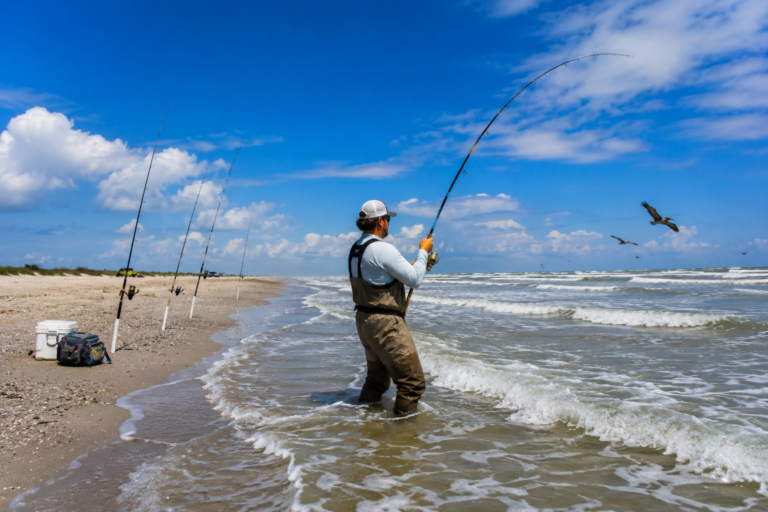
Fishing at Bolivar Peninsula covers three completely different environments within a few miles of each other — 27 miles of Gulf beach for surf fishing, the North Jetty for structure fishing into the Galveston Channel, and the bay side with access to East Galveston Bay’s marshes, flats, and channels. Each one targets different species with different techniques, and all three are accessible without a boat.
The peninsula runs from the ferry landing at Port Bolivar east to High Island, with the Gulf on the south side and Galveston Bay on the north. It’s one of those places where you can camp on the beach, walk to the water with a rod, and be fishing within five minutes of getting out of the truck. For families camping at Bolivar, fishing is built into the trip whether you planned it that way or not.
The Species
Redfish (Red Drum) — Year-Round, Peak in Fall
Redfish are the most reliable species on Bolivar Peninsula across all three environments — surf, jetty, and bay. They’re present year-round, but fall (September through November) is when they’re most active and most accessible. Bull reds in the surf in October, slot fish working the bay flats, and big fish under popping corks near the jetty — fall at Bolivar is redfish season.
Surf: Redfish work the gut between the first and second sandbars where baitfish get trapped. Cut mullet and live shrimp on a Carolina rig cast past the second sandbar and retrieved slowly through the gut. Look for nervous water — ripples and surface disturbance where redfish are pushing baitfish.
Bay side: Wading the shallow grass flats on the north side of the peninsula at low tide and targeting redfish tailing in the grass. One of the more technical and satisfying fishing experiences available at Bolivar — you’re sight-fishing to individual fish in shallow water.
Jetty: Big redfish hold on the rocks along both sides of the North Jetty. Cut crab, cut mullet, and live shrimp on the bottom near the rocks produce the largest fish.
Speckled Trout — Spring and Fall Peak
Speckled trout (spotted sea trout) are the glamour species of the Bolivar Peninsula fishery. They’re caught in all three environments but the bay side and the surf produce the most consistent trout fishing.
Best windows: Spring (April–June) and fall (September–November). Summer trout move deeper and early morning is the only reliable window. Winter trout concentrate in deeper bay channels during cold fronts.
Surf: Trout work the second sandbar chasing shrimp and small baitfish. Live shrimp under a popping cork is the standard approach. Soft plastic paddle tails on 1/4 oz jig heads retrieve through the trough between the sandbars also produce.
Bay side: Drifting the grass flats on the north side of the peninsula with soft plastics or live shrimp produces trout consistently in spring and fall. East Galveston Bay has extensive grass flat habitat that holds trout year-round.
Early morning advantage: Topwater plugs at first light over the flats and in the surf produce violent surface strikes in spring and fall. This is some of the most exciting fishing Bolivar offers — walking the dog on a topwater plug in low light with nobody else on the beach.
Flounder — Fall Migration Peak
Flounder run hard through Bolivar Peninsula in fall as they move from the bays to the Gulf to spawn. The fall flounder run — roughly October through December — is one of the most consistent events in SETX saltwater fishing.
Flounder are ambush predators that lie on the bottom waiting for bait to pass overhead. They hold along bottom transitions — where sand meets shell, where current creates an edge, where channels drop off into flats.
Best spots: The surf trough, bay channels on the north side of the peninsula, and the jetty base where current creates an edge. Finger mullet is the premier flounder bait — rig one on a jig head or on a Carolina rig and drag it slowly along the bottom. Mud minnows are the second choice.
Gigging at night: Flounder gigging at night on the shallow bay flats is a Bolivar tradition. Wading in knee-deep water with a light and a gig, spotting flounder lying on the bottom, and gigging them. All equipment and licensing requirements from TPWD apply — check current regulations before gigging.
Black Drum — Year-Round, Best in Spring
Black drum are present throughout the Bolivar Peninsula fishery year-round. They’re the most beginner-friendly of the major species — not particularly picky, strong fighters, and excellent table fare.
Best bait: Blue crabs (whole or cut), shrimp, and fiddler crabs. Black drum feed primarily by smell — keep the bait on the bottom and wait.
Jetty: The North Jetty is the best black drum spot on the peninsula. Black drum hold along the base of the jetty rocks feeding on crabs and mollusks that live on the structure. Use a fish-finder rig with a whole crab or crab pieces on a 5/0 or 6/0 circle hook.
Surf: Large black drum — bull drum over 30 inches — work the surf in spring and early summer. Cut mullet and crab on a heavy Carolina rig cast beyond the second sandbar.
Sheepshead — Structure Oriented, Year-Round
Sheepshead are the most structure-dependent fish on the peninsula. They live on the North Jetty rocks, on pier pilings, and on any hard structure in the bay. Small fiddler crabs, live shrimp, and small pieces of blue crab on a 2/0 or 3/0 hook fished directly on the structure produce sheepshead consistently. They’re bait thieves — detecting the bite requires attention and a fast hook set.
Spanish Mackerel and Other Gulf Species
During summer and early fall when green Gulf water pushes close to the beach, Spanish mackerel show up in the surf and around the jetty. Fast-moving shiny spoons and small white jigs retrieved quickly through the top of the water column trigger the mackerel strike. They’re one of the most exciting species to catch from the beach — fast, hard-fighting, and generally unannounced.
Pompano also appear in the surf during summer and fall. Small sand fleas (mole crabs collected from the surf edge at low tide) are the best pompano bait.
The Three Fishing Environments
Surf Fishing — Crystal Beach and the Open Beach
Twenty-seven miles of Gulf beach with drive-on vehicle access means you can position your truck right at the waterline, set up multiple rods in sand spikes, and fish in total comfort without ever leaving the truck. This is the most accessible fishing in SETX — park, stake your rods, sit in your chair, and wait.
Reading the surf: The productive zone is between the first and second sandbars — the gut or trough where baitfish get pushed by wave action and predators follow. Look for darker water between two lighter-colored strips of breaking waves — that darker strip is the gut. Cast past the second bar and retrieve through the gut slowly.
Best conditions: Incoming tide with light to moderate wave action. Calm, crystal-clear water means fish can see everything and are harder to fool. Green or slightly murky water with some wave action puts fish in a feeding mode.
Gear for surf fishing:
- Surf rod 10–12 feet for casting distance
- 20–30 lb braided main line with a monofilament leader
- Sand spike rod holders — fish multiple rods hands-free
- Carolina rig with a 2–3 oz pyramid sinker to hold bottom in the surf
- 5/0 or 6/0 circle hooks for redfish and black drum
North Jetty — Structure Fishing
The North Jetty at the end of 17th Street is Bolivar Peninsula’s most productive single fishing location. The rocks extend nearly a mile into the Gulf, creating habitat for virtually every species in the area — sheepshead and black drum on the base rocks, redfish along both sides, trout in the channel, and Spanish mackerel in the open water off the tip in summer.
Access: Free, 24 hours. Park at the end of 17th Street and walk out. The surface is concrete and walkable but can be slippery — wear closed-toe shoes with grip.
Bay side vs. Gulf side: The Gulf side has faster current and deeper water — better for mackerel, larger redfish, and black drum. The bay side is calmer with better sheepshead habitat directly on the rocks. Most anglers work both sides depending on what’s hitting.
Jetty gear:
- Medium-heavy rod, 17–20 lb braided line with fluorocarbon leader
- Popping cork with live shrimp for trout
- Fish-finder rig with crab for black drum and redfish on the bottom
- Small jigs and shiny spoons for mackerel when green water is present
Fort Travis Jetty: The jetty at Fort Travis Seashore Park on the west end of the peninsula also provides jetty fishing access. Sheepshead, black drum, and redfish hold on this structure as well.
Bay Side — East Galveston Bay
The north side of Bolivar Peninsula borders East Galveston Bay — a shallow, marsh-lined bay system with extensive grass flats, oyster reefs, and channels that hold speckled trout, redfish, and flounder throughout the year.
Wading the flats: Wade fishing in the shallow grass flats on the bay side is the technique that produces the largest speckled trout and the most rewarding redfish sight-fishing. Launch from any bay access point on the north side and wade the edges where grass meets open sand.
Kayak fishing: Launching a kayak from the bay side into East Galveston Bay gives access to areas the wade fisher can’t reach — the deeper channel edges, the back of pockets, and the grass flats further from shore. The bay is calm enough for a kayak on most days.
Drift fishing: Anchor up or drift through the grass flats with soft plastics on a 1/4 oz jig head or live shrimp under a popping cork. Let the tide move you and cover water until you find actively feeding fish.
Timing and Tides
Tides matter more at Bolivar than at most SETX fishing locations because the peninsula sits between the Gulf and the bay — both environments are heavily influenced by tidal movement.
Incoming tide: Pushes baitfish and smaller fish toward shore on the surf side. Brings clear Gulf water into the bay, activating feeding on the grass flats. Generally the best tide for surf fishing.
Outgoing tide: Drains baitfish out of the marsh and grass flats, creating ambush points where predators wait at the channel edges. Often the best time for wading the bay flats.
Best time of day: Sunrise for two hours is the peak window for topwater fishing in the surf and on the bay flats. The combination of low light, active predators, and surface-oriented feeding makes early morning the most exciting window. Late afternoon and evening are the second window. Midday summer fishing is the hardest.
License Requirements
A Texas fishing license with a saltwater fishing endorsement is required for all fishing at Bolivar Peninsula. Available at tpwd.texas.gov, tackle shops near Crystal Beach, or any sporting goods store.
Check current TPWD regulations for size and bag limits on all species — tpwd.texas.gov/regulations.
What to Bring
- Surf rod 10–12 feet for beach fishing
- Sand spike rod holders for hands-free multi-rod setup
- Popping cork rigs for trout on the bay side
- Soft plastic paddle tails in white and chartreuse
- Sunscreen SPF 50+ — the Gulf reflected glare is intense
- Picaridin insect repellent for evening fishing — bay side mosquitoes at dusk
- Cooler with ice — see our best camping coolers for Texas heat for what holds ice in full Gulf sun
FAQ
What fish can you catch surf fishing at Bolivar Peninsula?
Redfish, speckled trout, flounder, black drum, pompano, whiting, and Spanish mackerel during green water summer and fall periods. Redfish and black drum are the most consistent surf species year-round.
What is the best bait for fishing at Bolivar Peninsula?
Live shrimp covers everything — trout, redfish, flounder, and black drum all respond to it. Cut mullet is the top bait for redfish and large black drum in the surf. Finger mullet and mud minnows produce the most flounder.
Do you need a boat to fish Bolivar Peninsula?
No. All major species are accessible from shore — surf fishing from the beach, the North Jetty, and bay side wade fishing all produce quality fish without a boat.
When is the best time to fish Bolivar Peninsula?
Fall (September–November) for redfish and flounder. Spring (April–June) for speckled trout and flounder. Summer mornings for everything. Winter is the slowest season but sheepshead and redfish remain catchable year-round.
Is the North Jetty good for fishing?
Yes — the North Jetty is the single most productive fishing structure on the peninsula. Sheepshead and black drum on the rocks, redfish along both sides, trout in the channel, and Spanish mackerel in the open water. Free to access 24 hours.
Fishing at Bolivar Peninsula is built into the camping experience here whether you arrive intending to fish or not. The combination of surf, jetty, and bay in one place means there’s always somewhere producing something worth catching regardless of season or conditions.
For camping at Bolivar, see our complete Bolivar Peninsula beach camping guide. For crabbing on the peninsula, our Bolivar Peninsula crabbing guide covers the North Jetty spots, gear, and regulations. For the full Gulf Coast fishing and camping picture, see our Gulf Coast Texas camping guide.
Before your trip, grab the free Ultimate Family Camping Checklist — 83 items built for camping in Southeast Texas.
This post contains affiliate links. If you purchase through these links, we may earn a small commission at no extra cost to you. Thank you for supporting SETX Camping!