
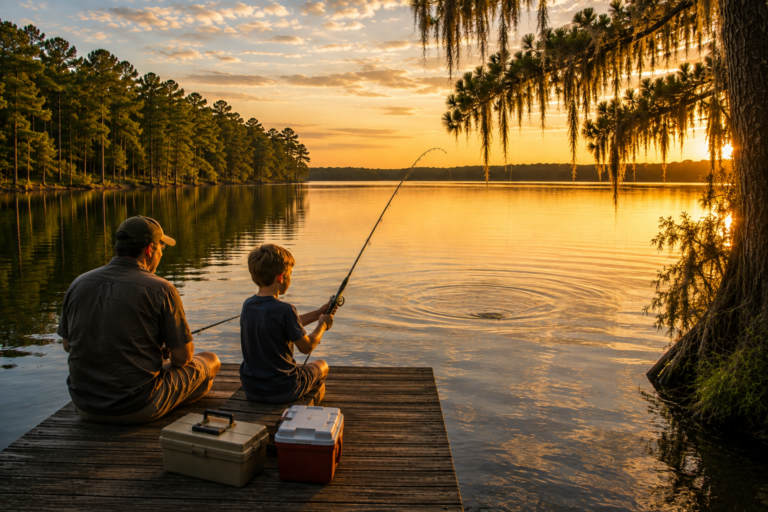
Fishing at Lake Livingston is built around two things the lake does better than most reservoirs in Southeast Texas: white bass and catfish. The white bass run up the Trinity River tributaries in early spring is one of the most consistent numbers-of-fish events on any SETX lake. The blue catfish fishery is rated excellent year-round by TPWD. Add striped bass around the US 190 bridge, solid crappie in the brush piles, and largemouth bass in the upper lake bays and creeks, and you have a reservoir that earns a trip from Beaumont or Houston on any given weekend from March through November.
Lake Livingston sits on the Trinity River in Polk, San Jacinto, Trinity, and Walker Counties — the dam in Polk and San Jacinto Counties, about 50 miles north of Houston and 75 miles north of Beaumont. The lake is large enough — roughly 90,000 acres — that different sections fish very differently depending on species and season.
Special regulations apply at Lake Livingston. Always check current rules at tpwd.texas.gov before fishing. Some fish species here have specific bag and size limits that differ from statewide standards.
Species — What TPWD Rates and What to Expect
White Bass — The Lake’s Signature Spring Fishery
White bass are the most exciting fishing Lake Livingston offers and the species that draws the most attention in spring. TPWD rates the white bass fishery as notable — the fish are plentiful and grow to good sizes here. The spring spawning run up the many creek tributaries that feed into Lake Livingston — particularly in the upper reaches of the reservoir — is the best time to be on this lake for action numbers.
During the run, white bass school up in the creek mouths and shallow tributary areas in good numbers. Small jigs, white twister tails, blade baits, and inline spinners all work. The fish are not picky during the run — they’re feeding aggressively and moving fast. Early morning on an incoming tide-influenced creek mouth in late February or March can produce consistent action for hours.
Outside of spring, white bass school up in deeper water — 15 to 25 feet — around main lake points, submerged creek channel intersections, and the deeper structure in the lower lake. Use a fish finder to locate the schools before fishing them. Vertical jigging with blade baits and small spoons works well on suspended schools.
Blue Catfish — Excellent Year-Round
The blue catfish fishery at Lake Livingston is rated excellent and is the most consistent fishing available on the lake outside of spring. Blue cats are present throughout the reservoir but concentrate in the main river channel, off-channel tributaries, and deeper creek runs where current and depth combine.
Cut bait — specifically fresh-cut shad or perch — is the standard approach on Lake Livingston for blue cats. Night fishing in summer along the main Trinity River channel with a Carolina rig and fresh cut bait on the bottom is the classic technique. Bottom fishing around the 190 bridge area and the deeper channel areas in the lower lake produces consistently.
Fish consumption advisory: Texas DSHS has advisories in effect for certain species at Lake Livingston. Check the current TDSHS consumption advisory before keeping any blue catfish or other species from this lake. Channel catfish, white bass, and crappie are generally not subject to the same restrictions — verify the current list before keeping your catch.
Channel Catfish — Good Year-Round
Channel catfish are available throughout the lake on a variety of organic and live baits. Less structure-dependent than blue cats — channel cats roam more widely and respond to stinkbait, chicken liver, and night crawlers as well as cut bait. The tributaries and creek mouths produce channel cats consistently from spring through fall.
Striped Bass and Hybrid Striped Bass — Best Around the 190 Bridge
The 190 bridge area is the signature striped bass location at Lake Livingston. Trolling and vertical jigging with spoons and live shad produces striped bass in this section of the lake. The bridge structure creates current breaks and depth variation that concentrate fish — particularly in the cooler months when stripers are more active.
Live shad is the top bait for stripers at Livingston. Find the shad schools with your fish finder and you’ll find the stripers nearby. Trolling diving crankbaits and umbrella rigs also produce when fish are spread out.
Largemouth Bass — Fair, Best in Upper Lake
Largemouth bass are fair overall at Lake Livingston but concentrated in specific areas that make them very catchable if you’re in the right section. The bays and creeks from the Kickapoo/Penwaugh area northward — the upper lake — are where largemouth bass are most frequently caught. The shallow, more vegetated upper reservoir provides the habitat bass need, and spring and fall are the most productive seasons here.
Spring bass move into the backs of pockets and creek arms to spawn — target these shallow areas with soft plastics on Texas rigs, spinnerbaits, and shallow crankbaits. Fall sends bass back shallow chasing baitfish — crankbaits and spinnerbaits covering water efficiently find the active fish.
Crappie — Good, Best on Fish Attractors
The crappie fishery at Lake Livingston is solid and well-suited to recreational anglers. TPWD has placed PVC fish attractor structures throughout the reservoir — these man-made structures concentrate crappie year-round and are the most reliable crappie spots on the lake.
Get current GPS coordinates for the fish attractors from local tackle shops in Livingston — the locations are not secret and local bait shops have the most current maps. Small jigs in white and chartreuse fished vertically over the attractors produce consistently. Spring spawn moves crappie shallow around timber and brush edges — 3 to 6 feet of water in creek arms and the upper lake.
Sunfish/Bluegill — High Numbers, Best for Kids
High numbers of bluegill and redear sunfish throughout the lake. The easiest fishing at Lake Livingston and the best entry point for kids or beginner anglers. Crickets, worms, and small jigs around vegetation and shallow structure produce consistently. The state park fishing pier is a good location for sunfish — no license required for shore fishing within state park boundaries.
Best Areas on the Lake
Upper Lake — Kickapoo/Penwaugh Area Northward
The northern section of Lake Livingston from the Kickapoo and Penwaugh Creek arms northward toward the Trinity River inlet is the best bass section on the lake. More vegetation, shallower structure, and the kind of varied creek arm habitat that largemouth bass favor. Spring bass fishing in this section rivals anything in the SETX region.
White bass also concentrate in the creek mouths of the upper lake during the spring run — the tributary mouths where smaller creeks dump into the main lake arms are the best spots.
US 190 Bridge Area
The bridge structure at US 190 is the signature striped bass location at Lake Livingston. Trolling and vertical jigging around and below the bridge produce stripers that aren’t found as consistently anywhere else on the lake. The bridge also concentrates catfish in the current breaks on the downstream side.
Main Trinity River Channel
The old Trinity River channel running through the center of the lake holds blue catfish throughout the year and concentrates fish in summer when heat drives them deeper. Follow the creek channel drops on your fish finder and bottom fish the deepest available structure.
State Park Fishing Pier
The Lake Livingston State Park fishing pier is the best bank access on the lake. Sunfish and crappie are consistent throughout the year. Catfish at night with cut bait. The pier is free with park entry — no separate fishing license required for shore fishing within the state park boundaries. The adjacent swim beach area is also fishable from the bank.
Seasonal Patterns
Spring (February–May) — Best Season Overall
White bass are the reason to be on Lake Livingston in February and March. The spawning run up the Trinity River tributaries is the most exciting fishing the lake offers — fish stacked in the creek mouths and moving hard upstream, feeding aggressively. By late March the run winds down and the focus shifts to largemouth bass spawning in the upper lake coves.
Crappie move shallow in March and April — target brush and timber edges in 3 to 6 feet throughout the upper lake arms.
Summer (June–August) — Night Fishing for Catfish
Summer at Lake Livingston is catfish season. The blue cat bite along the main channel and the deeper creek runs is most productive after dark — night fishing with cut shad from an anchored boat over the channel is the summer standard. The striped bass bite around the 190 bridge stays active early in the morning before the heat peaks.
Bass fishing in summer requires the same early-morning or late-evening approach that works across all SETX lakes — the midday heat pushes fish deep and slows the bite dramatically.
Fall (September–November) — Strong Comeback
Fall is the second best season at Lake Livingston. Bass return to more aggressive feeding patterns as temperatures drop from summer highs. Crappie and catfish both produce well through fall. White bass begin staging again by late October and November as pre-spawn movement begins.
Winter (December–January) — Slow But Possible
Catfish are the most reliable winter target at Livingston. Striped bass school up in the deeper sections of the lake and vertical jigging produces fish for those willing to work for them. Overall the slowest fishing of the year but the lake is quiet and the boat ramps are uncrowded.
Gear for Lake Livingston
White bass: Small jigs (1/4 oz) in white and chartreuse, inline spinners, blade baits. Light spinning tackle in the 6–8 lb range. Simple and effective.
Blue catfish: Medium-heavy spinning or baitcasting rod, 20–30 lb braided line, circle hooks 3/0–5/0 on a Carolina rig, fresh cut shad. Bottom fishing — let the fish take the bait, don’t set the hook hard with circle hooks.
Striped bass: Trolling rods with diving crankbaits, live shad rigs, umbrella rigs. The 190 bridge area requires heavier tackle to handle the current.
Largemouth bass: Standard bass tackle — medium-heavy rod, 15 lb fluorocarbon, Texas rig with a 10-inch worm for the upper lake timber and vegetation.
Crappie: Light spinning tackle, 1/16 oz jig heads with 1.5-inch grub bodies in white and chartreuse, 4 lb monofilament.
Polarized sunglasses — For reading the shallow upper lake structure where bass are spawning in spring.
Bank Fishing Options
Bank fishing at Lake Livingston is primarily limited to public access areas. The state park fishing pier is the best single bank fishing location — good for sunfish, crappie, and catfish. No license required for shore fishing within state park boundaries.
The Wolf Creek Park fishing pier provides another public pier option with a strong sunfish and crappie bite. The Corps of Engineers day-use areas around the lake provide additional bank access points.
License and Regulations
A Texas freshwater fishing license is required for all fishing on Lake Livingston outside of state park boundaries. Available at tpwd.texas.gov or tackle shops in Livingston.
Special regulations apply — Lake Livingston has specific bag and size limits for some species that differ from standard statewide rules. Check current TPWD regulations before fishing.
Alligator gar note: Special regulations govern alligator gar on the Trinity River system. Review current TPWD rules before targeting or retaining any gar from Lake Livingston or the Trinity River.
Fish consumption advisory: Check the current TDSHS advisory for Lake Livingston before keeping any catch.
FAQ
What is Lake Livingston best known for fishing?
White bass in spring and blue catfish year-round. The spring spawning run up the Trinity River tributaries is the most exciting fishing the lake offers. The catfish fishery is rated excellent by TPWD on a year-round basis.
What is the best time to fish Lake Livingston?
Late February through April for the white bass spawn. Spring and fall for largemouth bass in the upper lake. Year-round for catfish, with summer night fishing being the most productive catfish window.
Where are the best fishing spots on Lake Livingston?
The upper lake from Kickapoo/Penwaugh northward for largemouth bass. The 190 bridge area for striped bass. The main Trinity River channel for blue catfish. The fish attractor structures throughout the lake for crappie — get GPS coordinates from local tackle shops in Livingston.
Do you need a fishing license at Lake Livingston State Park?
No fishing license is required for shore fishing within the state park boundaries. A license is required for boat fishing and for all fishing outside the state park.
Are there alligator gar at Lake Livingston?
Yes. Special regulations apply to alligator gar on the Trinity River system — check current TPWD rules before targeting or retaining any gar.
For camping at Lake Livingston while you fish, see our complete Lake Livingston State Park camping guide and our Lake Livingston reservoir campgrounds comparison covering Wolf Creek Park, On The Lake RV Resort, and Bethy Creek Resort.
Before your trip, grab the free Ultimate Family Camping Checklist — 83 items built for camping in Southeast Texas.
This post contains affiliate links. If you purchase through these links, we may earn a small commission at no extra cost to you. Thank you for supporting SETX Camping!

