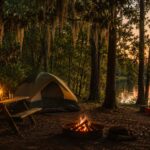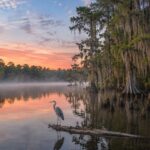
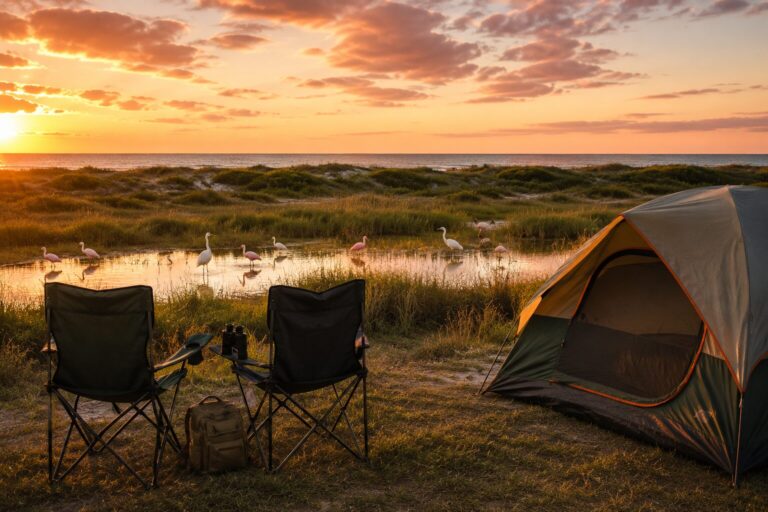
Camping at Galveston Island State Park means the Gulf of America on one side and Galveston Bay on the other — 2,000 acres of the last undeveloped land on Galveston Island, stretched across five distinct coastal ecosystems from Gulf beach and sand dunes to salt marsh, coastal prairie, lagoon, and bay. It’s 60 miles from Houston via I-45 and one of the most complete outdoor experiences on the upper Texas coast.
The beachside campground was completely rebuilt between 2019 and 2022 following years of hurricane damage — new concrete pads, covered shade shelters at every site, updated restrooms, and direct beach access make it the most modern beach campground on the Texas Gulf Coast. The bayside is quieter, closer to the marsh and bay, and the better side for birding. Together they give campers two genuinely different experiences within the same park.
Active Alerts — Check Before You Book
Short Boardwalk on Eskimo Curlew Trail: Closed until further notice due to damage from strong winds and high tides (as of April 17, 2026).
Some bayside boardwalks: Closed due to flood damage (as of January 2026). Observe closure signs for safety.
Bayside roads: Periodically closed due to high tide and weather conditions. As of June 15, 2026, bayside roads were closed June 17–18. Check tpwd.texas.gov/state-parks/galveston-island for current conditions.
Prescribed burns: Planned November through April depending on conditions. Some trails and areas may close temporarily.
Getting There
Address: 14901 FM 3005, Galveston, TX 77554
Phone: (409) 737-1222
Gate hours: 7am–10pm daily
Day use fee: $5/person/day (13+), children 12 and under free
From Houston: Take I-45 South to Galveston. Exit at 61st Street, take Seawall Boulevard west to FM 3005. Follow FM 3005 approximately 13 miles to the park entrance on the right. About 60 miles from most Houston neighborhoods — roughly 75–90 minutes depending on traffic and construction on I-45.
Tip: The park frequently reaches capacity on weekends, holidays, and during peak spring birding season. Day passes must be reserved in advance online through the Texas Parks and Wildlife reservation system. Don’t drive down without a reservation on a busy weekend — you may be turned away at the gate.
Reservations: texasstateparks.reserveamerica.com or (512) 389-8900
The Two Sides of the Park
FM 3005 divides the park into two distinct sections — beachside (south, Gulf-facing) and bayside (north, Galveston Bay). They’re different experiences and attract different visitors.
Beachside: Recently renovated, Gulf views, covered shade shelters, direct beach access, exposed and open with no tree cover. Best for families who prioritize beach time, swimmers, and RV campers who want to wake up 100 feet from the Gulf.
Bayside: Quieter, closer to the salt marsh and bay, kayak launch access, trail system through wetland and prairie habitats, and significantly better birding than the beach side. Best for birders, kayakers, and anyone who wants the natural habitat experience over the beach experience.
Both sides use the same entrance and share the park’s amenities — nature center, fish cleaning facility, and park programming.
Campsite Types — Complete Breakdown
Beachside Campsites with Water and Electric (36 sites — $20/night)
The main beachside campground sits in three loops facing the Gulf. Thirty-six sites with 30/50-amp electric and water — all on paved concrete pads, all with a covered shade shelter, picnic table, and fire ring. Restrooms with hot showers are located at loops one and three.
Current reviews consistently praise the 2022 renovation — level concrete pads that accommodate any RV size, clean bathhouse facilities described as recently built and well-maintained, covered picnic tables that make a genuine difference in a fully exposed coastal setting, and easy beach access from every site.
What you’re not getting: No sewer hookups anywhere in the park. No laundry. No shade beyond the covered table and shelter at each site. No trees. The beachside campground is wide open — Gulf breezes help in summer but the sites are fully exposed to sun, wind, and weather. A dump station is conveniently located between the beachside camping area and the day use area.
Fees (as of May 2026): $20–$35/night depending on season + $5/person/day entrance fee
Beachside Primitive Sites — Hike-In (15 sites — $15/night)
Tent-only walk-in sites on the beachside with water nearby and restrooms with showers available. Picnic tables and fire rings. For tent campers who want the Gulf experience at the lowest state park price point on this section of the Texas coast.
Bayside Electric Sites (20 sites — $20/night)
The bay side campground is 1.5 miles from the Gulf beach, positioned closer to the salt marsh and Galveston Bay. Water and 30/50-amp electric hookups, communal pavilion with shared fire rings. Note: picnic tables are not provided at each individual bayside electric site — the shared pavilion is the common space.
Maximum vehicle size is 18 feet on the bayside. Two vehicles per site.
The bayside in winter: Weekly ($120) and monthly ($500) non-peak rates are available November through February — one of the best-value winter beach camping options on the upper Texas coast for longer stays.
Bayside Water Sites (10 sites — $15/night)
Water hookups without electricity on the bay side. Picnic tables, shade shelters, fire ring with grill, restrooms with showers nearby. No vehicles over 18 feet. Good option for tent campers and small trailers who want the quieter bayside setting without needing power.
Primitive Dry Sites (10 sites)
Dry camping with no utilities or shade. Picnic tables and fire ring. For self-contained camping without hookups.
Beachside vs. Bayside — Which Should You Choose?
Choose Beachside if:
- Beach swimming and Gulf access is the primary reason you’re camping here
- You’re in an RV and need 30/50-amp electric with concrete pads
- You want the newly renovated facilities and modern amenities
- You’re bringing kids who will spend most of their time on the beach
Choose Bayside if:
- Birding is a priority — the marsh and bay habitat is significantly better than the exposed beachside
- You want to kayak the bay trails without crossing FM 3005 with your boat
- You want a quieter experience with fewer people
- You’re staying for a week or month in the off-season and want better rates
- Your RV is under 18 feet
Birding — The Park’s Most Underrated Feature
Galveston Island State Park is a recognized stop on the Great Texas Birding Trail (UTC 070) and one of the key sites for the annual FeatherFest birding festival that draws birders from across the country to Galveston Island each spring.
Over 300 bird species have been recorded in the park. The reason is the park’s position — it sits directly on the North and South American migratory flyway, meaning millions of birds crossing the Gulf of Mexico use the park’s coastal ecosystems as a rest and refueling stop during spring and fall migration. The combination of Gulf beach, dunes, freshwater ponds, salt marsh, and coastal prairie in 2,000 acres creates habitat diversity that draws species variety that a pure beach or pure marsh would not.
Spring migration (mid-March through mid-May) is the peak birding window. The bayside marshes are the best location — ibis, herons, egrets, terns, and migrating warblers, tanagers, and buntings all concentrate here. The observation tower on the bayside gives an elevated view over the entire park and marsh system. The trees adjacent to the nature trail should always be checked for migrants — exhausted birds coming off the Gulf drop into any available cover.
Year-round residents: Roseate spoonbills, great blue herons, snowy egrets, brown pelicans, laughing gulls, and a wide variety of shorebirds throughout the beach and marsh.
Best birding spots:
- Bayside observation tower — elevated view over the entire salt marsh
- Clapper Rail Trail — marsh habitat for secretive rails and wading birds
- Oak Mott Loop — mature live oak trees are excellent migrant traps
- Jenkins Bayou Paddling Trail — birding from a kayak in the marsh channels
Pick up the free “Birds of Galveston Island State Park” booklet at the nature center — covers the species most likely to be seen by season.
Trails
Clapper Rail Trail — Marsh habitat trail on the bayside. Best for wading birds and rails — the secretive Clapper Rail is the target species here and reliably present.
Oak Mott Loop — Through a cluster of live oak trees. During migration, these trees attract exhausted birds like a magnet — the variety visible in a single oak mott on a good migration morning can be extraordinary.
Heron’s Walk Trail — Passes through bayous, marshes, and salt flats. Good for wading birds and coastal wildlife throughout.
Eskimo Curlew Trail — Short Boardwalk CLOSED — This trail honors a species that once migrated through Galveston Island in enormous numbers and was likely hunted to extinction in the early 20th century. The short boardwalk section is currently closed due to storm damage as of April 2026. The ranger program “Soundscape Memorial: Honoring the Eskimo Curlew” — held at sunset on April 17, 2026 in collaboration with Wild Notes — reflects the park’s thoughtful approach to interpreting the natural and cultural history of this barrier island.
Beach Trail — Along the Gulf shoreline. Mostly exposed to full sun. Best in early morning. Check tide conditions before hiking close to the water line.
Paddling — Three Bay Trails
Three designated paddling trails launch from the Galveston Bay kayak launch, located on the bay road before the bayside camping area:
Dana Cove Trail — 2.6–2.8 miles
Open water bay paddling with scenic views of Galveston Bay. The most straightforward of the three trails — good for intermediate paddlers and anyone who wants bay views over marsh exploration.
Jenkins Bayou Trail — 2.9 miles
The quieter, more sheltered option. Winds through bayou marsh habitat ideal for spotting shorebirds and wading birds from the water. The most wildlife-dense paddling experience in the park.
Oak Bayou Trail — 4.2–4.8 miles
The longest and most challenging paddling trail. Routes through secluded bayous, coves, and seagrass beds. The best option for experienced paddlers who want the most immersive bay habitat experience.
Texas Camp Company is the official park outfitter at Lake Como on the bay side — kayak rentals and guided tours are available, with private tours on request. Check availability in advance by contacting the park at (409) 737-1222 or visiting the Texas Camp Company directly at the park.
Bring your own kayak or canoe if possible — rental availability can vary and advance planning is required for guided tours.
Fishing
Shore fishing, surf fishing, and bay fishing are all available at Galveston Island State Park. A fish cleaning facility is on site.
Gulf beach: Speckled trout and red drum are the primary surf fishing species. Early morning and late afternoon are the most productive windows.
Galveston Bay (bayside): Flounder and redfish are the main targets. The bay access from the bayside section also provides wade fishing opportunities in the shallower areas along the shoreline.
No fishing license required for shore fishing at a Texas state park. A license is required for any boat fishing in the bay.
Ranger program: Basic Fishing clinics run periodically throughout the year at no cost. Check the park events calendar for upcoming dates.
Ranger Programs
Galveston Island State Park runs one of the most active ranger program calendars of any SETX state park. Programs are free unless otherwise noted and cover a wide range of activities:
Regular programs:
- Spring Migration Bird Walks (multiple times weekly during migration season)
- Kayaking 101 / Sunset Paddle (evening bay paddles, registration required)
- Magical Morning Paddle on the Bay (registration required)
- Night Hike
- Beach Walk
- Bay Exploration
- Prairie on Fire: A Hike of New Growth (post-prescribed burn trail experience)
- Basic Fishing clinics
- Texas Outdoor Family 2-night camping workshops
Annual events:
- FeatherFest (April) — Galveston Island’s major birding festival, centered partly on the state park
- Adopt-a-Beach cleanups
Check the park events calendar before any trip — the program schedule changes monthly and booking requirements vary.
Nature Center
The park’s nature center on the bayside houses interactive exhibits about local plant and animal life on the barrier island. Boardwalks from the nature center lead to overlooks of nearby freshwater ponds — good for beginning birders and families with young children who want a structured introduction to the park’s wildlife before heading to the trails.
Wildlife
Birds: 300+ species, peak diversity during spring and fall migration. Year-round: roseate spoonbills, brown pelicans, great blue herons, tricolored herons, snowy egrets, laughing gulls, killdeer, and various shorebirds. Migration: warblers, tanagers, buntings, vireos, grosbeaks in the oak motts and marsh edges.
Marine life: Blue crabs and various fish in the bay. Dolphins regularly seen offshore and in the bay shallows — the Galveston-Bolivar Ferry dolphin sightings are well documented, and the park’s bay side provides similar viewing opportunities from shore.
Coyotes: Present on the park grounds. Not aggressive toward humans — an occasional dawn or dusk sighting near the marsh edges.
Mosquitoes: Year-round nuisance per TPWD’s own park description. The bayside marsh is worse than the beachside. Bring repellent on every trip regardless of season. See our complete insect repellent guide for Texas camping.
What to Pack
The standard Gulf Coast SETX kit applies here with a few specifics for Galveston Island State Park:
DEET or Picaridin insect repellent — Year-round on the bayside, significant on the beachside at dawn and dusk.
Binoculars — Non-negotiable for anyone visiting during spring or fall migration. A compact pair fits in any pack and pays for itself on the first morning in the park.
Canopy or shade structure — The beachside campground has covered shelters at each site but no natural tree shade. A pop-up canopy adds usable shade around the covered table during midday hours.
Quality cooler — Full Gulf Coast sun exposure on the beachside accelerates ice melt. Pre-chill, keep in shade, follow the 2:1 ice ratio.
Life jackets for anyone paddling the bay trails. Required for children under 13.
Rain gear — Galveston Island’s position makes it fully exposed to Gulf weather. Afternoon thunderstorms in summer and fast-moving coastal fronts in fall and winter arrive with limited warning.
Best Time to Visit
Spring (mid-March through May) — Best for birding
The park’s peak season. Spring migration brings extraordinary diversity to the oak motts and marsh. The FeatherFest festival draws the birding community to Galveston Island in April. Book camping and day passes well in advance — the park reaches capacity regularly during spring weekends.
Fall (October–November) — Best overall
Migration peaks again in fall. Temperatures break, crowds drop after Labor Day, and the beach is at its most enjoyable. Fall shorebird migration adds diversity to the beach and mud flat habitats. The quietest version of a good park.
Winter (December–February) — Best value, best for longer stays
Weekly and monthly rates on the bayside electric sites make this the most cost-effective window for extended stays. Waterfowl arrive on the bay in significant numbers. Cold fronts can be genuinely cold on an exposed barrier island — bring real cold-weather gear for the nights.
Summer (June–September) — Busiest, most challenging
The park is at its most crowded from Memorial Day through Labor Day. Beach traffic is heavy, day passes sell out, and heat plus mosquitoes peak simultaneously. Hurricane season runs June through November — monitor the National Hurricane Center before any Gulf Coast camping trip. The park closes when a hurricane threatens.
FAQ
Does Galveston Island State Park have beachfront camping?
Yes. The beachside campground puts you within walking distance of the Gulf beach with covered shade shelters, 30/50-amp electric and water hookups at each site, and restrooms with showers at multiple locations. The 2019–2022 renovation made this one of the most modern beach campgrounds on the Texas Gulf Coast.
Does Galveston Island State Park have full hookup RV sites?
No. The park does not have sewer hookups at any site. Electric and water are available on the beachside and bayside. A dump station is located between the beachside camping area and the day use area.
Do you need a reservation at Galveston Island State Park?
Yes for camping, and strongly recommended for day use. The park frequently reaches capacity on weekends and holidays. Day passes must be reserved in advance through the Texas Parks and Wildlife system. Camping reservations open up to 5 months in advance, lodges up to 12 months.
Is Galveston Island State Park good for birding?
Yes — it’s one of the best birding locations on the upper Texas coast. Over 300 species recorded, situated on the North and South American migratory flyway, and a key site for the annual FeatherFest festival. The bayside marsh and oak mott habitats are the best areas. Spring migration from mid-March through mid-May is the peak window.
Can you kayak at Galveston Island State Park?
Yes. Three designated paddling trails (Dana Cove, Jenkins Bayou, and Oak Bayou — 2.6 to 4.8 miles) launch from the bay-side kayak launch. Texas Camp Company operates as the official park outfitter with kayak rentals and guided tours. Bring your own kayak for the most reliable access.
How far is Galveston Island State Park from Houston?
Approximately 60 miles via I-45 South to Galveston, then FM 3005 west approximately 13 miles. About 75–90 minutes from most Houston neighborhoods depending on traffic.
Galveston Island State Park is the most developed and most accessible Gulf Coast camping experience in the upper Texas region. The renovated beachside campground puts you literally steps from the Gulf with amenities that most coastal campgrounds don’t offer. The bayside gives you a completely different park — quiet, wild, and exceptional for birding and paddling.
For the complete Gulf Coast camping comparison — including Sea Rim State Park and free beach camping at Bolivar Peninsula — see our Gulf Coast Texas camping guide. For more campgrounds across Southeast Texas, our complete guide to the best campgrounds in Southeast Texas covers the full region.
Before your trip, grab the free Ultimate Family Camping Checklist — 83 items across 7 categories, built for camping in Southeast Texas.
This post contains affiliate links. If you purchase through these links, we may earn a small commission at no extra cost to you. Thank you for supporting SETX Camping!