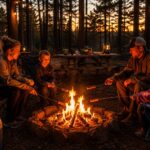

Camping at Brazos Bend State Park puts you 45 miles southwest of Houston in one of the most genuinely wild settings anywhere in the Texas Gulf Coast region. Wildlife biologists estimate between 250 and 350 adult alligators live in the park’s 1,000-plus acres of water. Over 300 bird species have been documented here. The George Observatory — one of the largest public-access telescopes in the United States — sits inside the park boundaries and opens Saturday nights for public stargazing.
For families coming from Houston, it’s 45 minutes from downtown. For kids who’ve never seen a wild alligator from 30 feet away, it’s a first camping trip they won’t forget.
Active Alerts — Read Before You Book
Prescribed burns: Brazos Bend conducts prescribed burns August through April depending on weather conditions. Some camping areas, trails, and day-use facilities may temporarily close during burn operations. Smoke may impact your visit. Call the park at 979-553-5101 before your trip to confirm current conditions.
Trail closures: Certain trails close frequently after heavy rain. Contact the park for the most current trail status before your trip.
Brazos Bend 50 Run: The annual trail running event takes place in April. On race day, trail activity is significantly higher than normal and parking is limited. Check the park calendar if your trip is in April.
Getting There
Address: 21901 FM 762, Needville, TX 77461
Phone: 979-553-5101 or 979-553-3400
GPS: 29.37088, -95.63183
From Houston: Take US-59 South toward Victoria. Exit at Crabb River Road/FM 2759. Turn left (east) onto FM 2759 and go approximately 2.5 miles to the park entrance.
Gate hours: 8am–10pm daily
Important: Gate codes are not given out without a reservation. Campers with reservations must contact the park between 8am–5pm on the day of arrival to receive the gate code. Arriving after 10pm requires contacting the park earlier that same day.
Entrance Fees
- Adults (13+): $7 per day per person
- Children 12 and under: Free
- Texas State Parks Pass covers daily entry for the cardholder and all passengers in their vehicle
Day passes are available online and sell out on busy weekends. Pre-purchase your day pass at texasstateparks.reserveamerica.com if you’re visiting on a weekend or holiday — the park regularly reaches capacity on peak days.
Campsite Types and Fees
Burr Oak Camping Area — Water and Electric Sites
The Burr Oak loop is one of the two main developed camping areas at Brazos Bend. Water and electric hookups — no sewer — on sites that are consistently described as clean, level, and well-spaced. Good tree cover through most of the loop.
No sewer hookups anywhere in the park. If you need full hookups, Brazos Bend is not the right campground — the park offers water and electric only. A portable waste tank solves the sewer situation for RV campers who want to stay regardless.
Red Buckeye Camping Area — Water and Electric Sites
The Red Buckeye loop contains the water and electric sites numbered in the 200s (sites 201, 203, 204, 206, 213, 218, 219, 226, 233, and others). Sites in this area are well-maintained, level, and clean. The loop has similar amenities to Burr Oak — water, electric, restrooms with showers nearby.
Site fees: $15–$25 per night depending on amperage and attributes
Primitive Walk-In Sites
Walk-in sites with no hookups positioned 35–70 yards from the parking area. Best for tent campers who want a real outdoor experience at a genuinely affordable price point. No generator noise from neighboring RVs — the walk-in distance naturally separates these sites.
Site fees: $12 per night
Screened Shelters
Available at $25 per night. For campers arriving after the office closes at 5pm, the Iron Ranger Box at park headquarters handles self-pay — fill out the envelope completely, attach the white copy to your windshield, and report to headquarters by 9am the next morning.
Cabin
One cabin available at $75 per night. A cleaning deposit is required and must be paid over the phone. Cabin arrivals after 5pm require calling the park between 8am–5pm on arrival day — staff will contact the on-duty host to unlock the cabin.
Group Camping
$25–$40 per night — restricted to nonprofit youth organizations only. Individuals and adult groups are not eligible for group camping at Brazos Bend. Must walk 25–50 yards from the parking lot. Restrooms are one-quarter mile away.
Reservations: texasstateparks.reserveamerica.com or call (512) 389-8900
Reservations open: Up to 12 months in advance
The Alligators — What to Actually Expect
This is the thing most people come to Brazos Bend to see, and it delivers. Between 250 and 350 adult alligators are estimated to live in the park — and that doesn’t count the juveniles in the marsh areas. The 40 Acres Lake area is the most reliable viewing spot. On a morning walk around the lake, seeing 10–15 alligators on or near the bank is a typical experience, not an exceptional one.
Safety rules that are strictly enforced:
- Maintain at least 30 feet of distance at all times
- Never feed alligators under any circumstances — it is illegal and it teaches them to associate humans with food
- Keep children and pets away from the water’s edge and any shoreline area
- Do not approach alligators that are on the trail or path — give them space and wait for them to move
- Alligators are most active at dawn and dusk
No swimming or boating of any kind is allowed anywhere in the park. This isn’t a recommendation — it’s a hard rule directly tied to the alligator density. The water is entirely off-limits for entry.
The nature center near the park entrance has live exhibits of baby alligators, snakes, and arachnids alongside detailed interpretation of the alligator life cycle. Ranger programs on alligators run throughout the year — check the park events calendar before your trip.
The George Observatory — Don’t Miss This
The George Observatory is one of the most unique features of any state park in Texas. Operated by the Houston Museum of Natural Science, it sits inside the park boundaries and is open to the public every Saturday evening year-round (weather permitting) for public telescope viewing.
The telescopes: The centerpiece is the 36-inch Gueymard Research Telescope — one of the largest telescopes accessible to the general public in the United States. Two additional telescopes (an 18-inch and a 14-inch) are also available.
Tickets: Must be purchased in advance at hmns.org/george-observatory/admission. Park entry ($7/person) is not included with your observatory ticket — it’s a separate charge. Plan for both when budgeting.
For campers: Saturday night at Brazos Bend with an observatory reservation is a genuinely exceptional combination — campfire in the evening, alligator count at dusk, and research-grade telescope views of the night sky. If you’re planning a weekend trip, time it for a Saturday.
You can also bring your own telescope — Brazos Bend is far enough from Houston’s light pollution to offer solid amateur astronomy conditions on clear nights.
Trails — 37 Miles Across Multiple Ecosystems
Brazos Bend has more trail variety than most people expect for a Gulf Coast park. The terrain covers coastal prairie, live oak savannah, lowland forest, wetland sloughs, and lake edges — genuinely different ecosystems within the same park.
Creekfield Nature Trail — Best for Beginners and Families
Paved, ADA accessible. The easiest and most accessible trail in the park — flat, well-maintained, and passes through excellent wildlife habitat around Creekfield Lake. This is the trail used for many ranger programs. First-time visitors and families with young children should start here.
40 Acres Lake Trail — Best for Alligator Viewing
A one-mile loop around 40 Acres Lake with a playground, observation tower, fishing dock, and picnic tables along the route. The trail passes through the highest-density alligator viewing area in the park. A morning walk here is the defining Brazos Bend experience for most visitors. The observation tower gives an elevated view over the lake and surrounding marsh.
Pilant Lake Trail — Best for Birding
Pilant Lake is the park’s premier birding area — the shallow water and marsh edges attract wading birds, waterfowl, and shorebirds throughout the year. Over 300 bird species have been documented at Brazos Bend. During spring and fall migration the variety is exceptional. Bring binoculars.
Big Creek Loop — For Longer Hikes
The longer loop options at Brazos Bend pass through live oak savannah and bottomland forest away from the main lake areas. More solitude, less alligator viewing, more deer and other forest wildlife. Good for campers who want a full day on the trail.
Trails are for hiking, biking, and horseback riding — all three are permitted on most trail sections. Equestrian campers can use the primitive equestrian campsite.
Important: Some trails close after heavy rain — the wet clay soil around the wetland areas can make certain sections genuinely impassable. Contact the park at 979-553-5101 before your trip for current trail conditions.
Birding at Brazos Bend
Brazos Bend is one of the top birding destinations in Texas. Over 300 species documented. The combination of wetlands, prairie edge, and bottomland hardwood forest creates diverse habitat that attracts both resident species and massive numbers of migrants in spring and fall.
What to look for:
- Great blue herons, great egrets, and tricolored herons working the lake edges year-round
- Roseate spoonbills in the shallow marsh areas — one of the signature SETX birds
- Anhinga drying their wings on lakeside branches
- Wood ducks in the wooded wetland areas
- Spring migration (April–May): warblers, tanagers, orioles, vireos coming through in waves
- Winter waterfowl (November–February): ducks, coots, and grebes on the lakes
Ranger-led birding hikes run throughout the year — the park events calendar lists current program dates.
Fishing
Fishing is permitted in the park’s lakes and ponds. Largemouth bass, catfish, and various sunfish species are all present. Bank fishing from designated areas only — no boats or kayaks in the water under any circumstances.
Texas freshwater fishing license required. Available online at tpwd.texas.gov or at the park store.
The Nature Center
The park nature center features live exhibits of baby alligators, snakes, and arachnids — consistently described as a highlight for kids. Staffed by knowledgeable volunteers who run scheduled ranger talks. A small store inside stocks cold drinks, snacks, and souvenirs.
Texas Outdoor Family Program
TPWD runs Texas Outdoor Family camping workshops at Brazos Bend throughout the year — specifically designed for families who’ve never camped before. The park provides basic camping equipment, rangers guide activities, and the whole program costs $75 for a one-night event or $95 for two nights for a family of up to six people (includes all park and camping fees).
If you want to try camping before investing in gear, this is the most supported way to do it in Southeast Texas. Check availability at tpwd.texas.gov/calendar/tof.
What to Pack for Brazos Bend
The standard SETX camping kit applies, with a few specific additions:
- DEET or Picaridin insect repellent — the wetland setting produces real mosquito pressure at dawn and dusk year-round
- Binoculars — for birding and for watching alligators from the safe 30-foot distance. Bring a pair for every interested person, including kids
- Quality cooler — SETX summer heat applies here the same as everywhere in the region
- Camera with zoom lens — Brazos Bend is one of the best wildlife photography locations in the US. A long zoom gets you close to alligators and birds without violating the 30-foot safety rule
- Rain gear — prescribed burns and trail closures aside, Brazos Bend is wetland country and afternoon storms are frequent in warm months
- Portable waste tank if RV camping — the park has no sewer hookups
If you’re putting together your full camp kit, see our best camping gear for Texas guide and our complete budget camping gear picks.
Best Time to Visit
Fall (October–November): The best camping window. Heat and humidity break, mosquitoes thin out, and fall migration through the wetlands is exceptional for birding. October mornings at Brazos Bend are some of the best wildlife watching of the year.
Spring (March–May): Peak alligator activity as temperatures rise and breeding season approaches. Spring migration brings spectacular bird diversity. Weekends book out fast — plan ahead.
Summer (June–August): Hot and genuinely humid. Alligators are active year-round. Mosquitoes are significant near the water. Start hiking by 8am and be back at camp before noon in July and August. The park is beautiful even in summer for campers who respect the heat.
Winter (December–February): Cool, quiet, and excellent for birding. Waterfowl on the lakes in significant numbers. Alligators are less active in cold weather but still present. Light crowds make winter one of the most pleasant times to camp here.
FAQ
Are there really alligators everywhere at Brazos Bend State Park?
Yes — wildlife biologists estimate 250–350 adult alligators in the park, plus countless juveniles. The 40 Acres Lake area offers the most reliable viewing. Alligators are present throughout the park near any water. Follow the 30-foot distance rule, never feed them, and keep children and pets away from the water’s edge.
Can you swim at Brazos Bend State Park?
No. Swimming, wading, and boating of any kind are strictly prohibited throughout the park due to the high density of alligators. All park water is off-limits for entry.
Is the George Observatory free?
No. Observatory tickets must be purchased separately in advance at hmns.org/george-observatory/admission/. Park entry ($7/person) is also charged separately — plan for both. The observatory is open Saturday evenings year-round, weather permitting.
Does Brazos Bend State Park have full hookup RV sites?
No. The park has water and electric sites only — no sewer hookups. This is the most commonly mentioned limitation in reviews from RV campers. Campers who need sewer hookups should plan for a nearby dump station or use a portable waste tank.
How far is Brazos Bend State Park from Houston?
Approximately 45 miles southwest of downtown Houston, about 45–60 minutes depending on traffic. One of the closest truly wild camping experiences to the Houston metro.
Is Brazos Bend State Park good for kids?
Yes — it’s one of the best family camping parks near Houston. The alligator sightings are reliably impressive for kids, the 40 Acres Lake loop has a playground and observation tower, the nature center has live exhibits, and ranger programs are designed with families in mind.
Do you need a reservation at Brazos Bend State Park?
For camping, yes — reservations are strongly recommended, especially on weekends. The park also fills to capacity for day use on busy weekends — pre-purchase day passes online to guarantee entry.
Brazos Bend is the camping trip most Houston families should have taken years ago and haven’t yet. The alligators alone are worth the 45-minute drive — and the George Observatory on a clear Saturday night turns a good camping trip into something genuinely memorable.
For more campground options within driving distance, see our camping near Houston with kids guide and our complete guide to the best campgrounds in Southeast Texas. For family camping strategy from gear to food, our Ultimate Guide to Family Camping in Texas covers everything.
Before you go, grab the free Ultimate Family Camping Checklist — 83 items across 7 categories, built for camping in Southeast Texas.
This post contains affiliate links. If you purchase through these links, we may earn a small commission at no extra cost to you. Thank you for supporting SETX Camping!