Crabbing at Bolivar Peninsula is one of those activities that shows up on every family camping trip out here eventually — usually because someone walks down to the North Jetty, watches another family pulling crabs off the rocks with a chicken neck on a string, and decides they need to be doing that immediately.
It’s that easy to get into and that satisfying when you do it right. Blue crabs are abundant in the bay-side waters of the Bolivar Peninsula all year, with the best action running from late spring through early fall. A fishing license, a chicken neck from the grocery store, and a dip net are all you need to go home with a bucket of crabs.
Here’s everything you need to know before you get there.
The Best Spots for Crabbing on Bolivar Peninsula
North Jetty — The Primary Destination
The North Jetty is the most consistent and most accessible crabbing spot on Bolivar Peninsula. Located at the end of 17th Street off Highway 87, about two miles east of the ferry landing, the jetty extends nearly a mile into the Gulf and is free to access 24 hours a day.
Walk the jetty to the rocks and you’ll find two environments: the Gulf side with deeper, faster-moving water, and the bay side with calmer, shallower marsh and channel habitat. For crabbing, the bay side and the rocks themselves are where the crabs concentrate. Blue crabs love structure — the jetty rocks give them exactly that, along with the tidal current that brings baitfish and organic material moving through on every tide change.
The North Jetty is genuinely family-friendly for crabbing. You don’t need a boat, the access is flat and walkable, and the kids can run multiple lines off the rocks while the adults keep track of what’s been pulled and what needs to go back. The crabbing is social enough that you’ll almost certainly be sharing the space with other families doing the same thing.
Getting there: Exit the ferry and head east on Highway 87. The road to the North Jetty is about two miles from the ferry landing. Turn toward the Gulf on 17th Street. You’ll see the jetty structure.
The Bay Side — Intracoastal Waterway and Bay Channels
The north side of the Bolivar Peninsula runs along the Intracoastal Waterway and East Galveston Bay — the leeward side of the peninsula where the water is calmer, shallower, and rich with the marsh habitat that blue crabs spend most of their life in.
Any saltwater pass, slough, roadside drainage ditch, or canal along the bay side of the peninsula holds crabs. The spots where rock groins or any hard structure meets the bay water are the most productive — the same structure-seeking behavior that makes the North Jetty productive applies anywhere you find rocks or pilings in the bay.
Broken Bridge area: On the northwest side of Bolivar, accessible from the ferry side. Exit the ferry east on Highway 87, take 7th Street left toward the bay, pass the historic Bolivar lighthouse (worth a stop and a photo), and continue about a half mile to the Overton Avenue area. The bay access points here put you on calm water with good crab habitat right off the road.
Anywhere Along the Bay Roadside
The honest answer to “where do I crab on Bolivar” is: find water on the north side of Highway 87, drop a line, and see what happens. The bay-side sloughs and channels that run parallel to the road throughout the peninsula are full of blue crabs from May through October. A chicken neck tied to a string dropped off any bridge, dock, or bank access on the bay side is going to find crabs.
Texas Blue Crab Regulations — Know Before You Go
These regulations are current through August 31, 2026. Always verify at tpwd.texas.gov before any trip.
License Required
A valid Texas fishing license with a saltwater fishing endorsement is required for crabbing in public coastal waters. Children under 17 are exempt from the license requirement — adults are not. License available at tpwd.texas.gov or any tackle shop near Crystal Beach.
Size Limit
5-inch minimum carapace width for blue crabs — measured across the widest point of the body from the tip of one spine to the tip of the other. If you’re not sure whether a crab is legal, measure it. Undersized crabs go back in the water immediately.
You may possess up to 5% undersized crabs for bait purposes only, kept in a separate container from your keepers.
No Bag Limit
Texas has no daily bag or possession limit on blue crabs for recreational crabbers. Take what you’ll eat.
Sponge Crabs — Release Immediately
A female blue crab carrying eggs has a spongy orange or yellowish mass visible under her abdominal flap — these are called sponge crabs or egg-bearing crabs. You cannot keep sponge crabs. Release them immediately and gently. Protecting egg-bearing females is how the blue crab population stays healthy.
How to Tell Males from Females
Flip the crab upside down and look at the abdominal apron — the triangular flap on the underside:
- Male: Narrow, pointy apron shaped like the Washington Monument
- Mature female: Broad, rounded apron shaped like the Capitol dome
- Juvenile female: Triangular like the male — looks just like a male until she matures
You cannot possess a female with her abdominal apron removed.
Annual Crab Trap Closure
From February 21 through March 2 each year, all crab traps must be removed from coastal waters. This is a statewide closure that allows TPWD and volunteers to remove abandoned “ghost” traps that continue catching and killing crabs year-round. Hand lines, dip nets, and folding traps remain legal during this period.
Stone Crabs
Stone crabs are also present in Bolivar waters — heavier, darker crabs with large claws. If you catch one, only the right claw may be kept (minimum 2.5 inches measured from tip to first joint). The body must be returned to the water immediately — stone crab claws regenerate.
The String and Chicken Neck Method
This is the classic Gulf Coast crabbing technique and the one I’d recommend over traps for a family camping trip. It’s interactive, it keeps kids engaged, and it’s genuinely effective.
What you need:
- Chicken necks or thighs (get at any grocery store — HEB, Walmart, or the Crystal Beach area stores all carry them)
- Kite string or twine — 8 to 12 feet per line
- Small fishing weight or washer to keep the bait on the bottom
- Long-handled dip net — the longer the better for reaching crabs off the jetty rocks
- Bucket or cooler to hold your catch
- Gloves — blue crab claws are serious
How to do it:
Tie one end of your string to a stake, a piling, a railing, or anything stable. Tie the weight and the chicken neck to the other end and toss it into the water. The chicken neck needs to reach the bottom — if it’s floating, add more weight.
Wait. Blue crabs find bait by smell and current, not by sight. Give it 5–10 minutes before checking. When you’re ready to check, pull the string in slowly and steadily. A crab feeding on the chicken neck will hold on longer than you’d expect — pull gently and keep the bait in the water as long as possible.
When the bait is within reach, slide the dip net under the crab from below and scoop upward. Don’t try to net from above — you’ll spook the crab off the line.
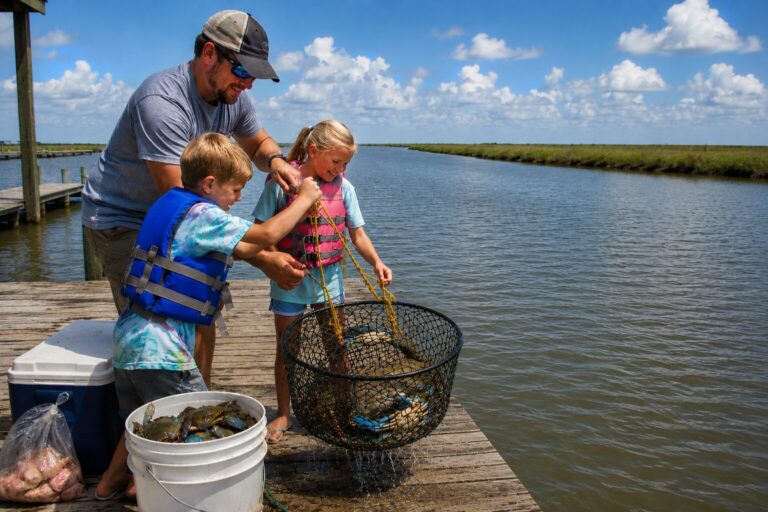
Multiple lines: Rig 4 to 6 lines and space them along the rocks or bank. This is where the activity level picks up — you’ve got kids watching each line, taking turns pulling and netting, measuring the catch. For families with young kids, this is one of the best activities on Bolivar. The crabs do most of the work.
Drop Net / Umbrella Net Method
The drop net (umbrella net) is a circular collapsible net with bait attached to the center. Lower it to the bottom, wait 10–15 minutes, then pull straight up quickly to trap crabs that have moved onto the net to reach the bait.
More passive than the string method but covers more bottom area. Good for fishing from a bridge or dock where dropping straight down is more practical than working a horizontal line. A collapsible crab net with a bait clip in the center is the standard setup.
Crab Traps
Crab traps (crab pots) are wire box traps that catch crabs continuously while you’re away. They require marking with a gear tag bearing your name and address and must be removed before February 21 annually. For a camping trip where you can check the trap morning and evening, a folding panel crab trap that collapses flat is the most practical option to bring in the truck.
The trap goes in a bay-side channel with a chicken neck or fish scraps inside, marked with your gear tag. Pull it twice a day and keep anything legal.
What to Bring — The Crabbing Kit
- Long-handled dip net — 4–6 foot handle minimum for jetty crabbing
- Chicken necks — 1 pack feeds multiple lines for a full day
- Kite string — one roll covers a lot of lines
- Small fishing weights — 1/2 oz to 1 oz keeps the bait on the bottom
- 5-gallon bucket with a tight lid or a cooler for the catch
- Crab gloves — blue crab claws will draw blood without them
- Measuring device — a 6-inch ruler or a crab gauge for quick legal checks
- Texas fishing license with saltwater endorsement — adults only, available at tpwd.texas.gov
Best Times to Crab at Bolivar
Season: Blue crabs are active year-round in Texas coastal waters but peak from May through October when water temperatures are highest and crabs are most mobile and aggressive.
Time of day: Tidal changes are the most productive windows — roughly two hours before and after high tide. Crabs move actively with the current, bringing them within reach of bait and toward the structure where you’re fishing. Early morning and late afternoon/evening tend to produce better than midday in summer.
Moon phase: Full and new moon tides are larger and more active, moving more water and more crabs. If you have flexibility in when you go, planning around a full or new moon adds up over a season.
Water clarity: Crabs find bait by smell, not by sight — murky water after rain is not necessarily bad crabbing. Some of the best crabbing happens in slightly stirred-up water where crabs are moving more actively.
Cooking What You Catch
A bucket of fresh blue crabs cooked at camp that evening is the payoff for the whole activity. Here’s the basic approach:
Boiled blue crab:
Fill a large pot with water, bring to a rolling boil, add a generous pour of Zatarain’s Crab Boil or Old Bay seasoning — more than you think you need. Add the live crabs, cover the pot, and boil for 12–15 minutes until they’re bright orange-red. Pull them out, let them cool enough to handle, and eat them at the picnic table with melted butter, corn, and cold drinks.
What you’ll need at camp:
- Large pot (at least 5-gallon for a full catch)
- Propane camp stove or use a campfire with a grate
- Zatarain’s or Old Bay seasoning
- Seafood crackers or a wooden mallet for the claws
- Newspaper or paper bags on the table
Simple Camp Boil Recipe
You caught the crabs. Here’s exactly how to cook them at camp from start to finish.
What you need:
- Large pot — 5 gallons minimum for a full batch. A cheap aluminum crawfish pot from Walmart works perfectly and costs around $20.
- Enough water to fill the pot halfway
- 1 bag Zatarain’s Crab Boil (the bag kind that goes in the water, not the liquid — use both if you want serious flavor)
- 1 lemon, halved
- 1 tablespoon salt
- Optional: corn on the cob cut into thirds, small red potatoes, smoked sausage cut into chunks — all go in the same pot
Step 1 — Fill and season the pot
Fill your pot halfway with water. Drop in the Zatarain’s bag, squeeze in the lemon and toss the halves in, add the salt. Bring the whole thing to a full rolling boil over your camp stove or a propane burner. This takes longer than you expect — 15 to 20 minutes to get a big pot boiling outside. Start it before you think you need to.
Step 2 — Add extras first if using them
If you’re adding potatoes, put those in first — they take the longest, about 15 minutes. Corn goes in after 5 minutes. Sausage goes in with the crabs. Taste the water after the potatoes have been in a few minutes — it should be noticeably salty and spicy. If it tastes like plain water, add more seasoning now.
Step 3 — Add the crabs
Live crabs go in headfirst — it’s the most humane and quickest method. Drop them in all at once, put the lid on, and keep the heat on high. The water will stop boiling briefly when the cold crabs go in. Once it returns to a full boil, start your timer.
Cook time:
- Small crabs (5–5.5 inches): 12 minutes
- Medium crabs (5.5–6 inches): 15 minutes
- Large crabs (6+ inches): 18 minutes
The crabs are done when they’re bright orange-red all over with no gray remaining. When in doubt, pull one out and check — the meat inside should be white and firm, not translucent.
Step 4 — Pull and rest
Use tongs to pull the crabs out onto a sheet of newspaper or into a clean ice chest. Let them rest for 5 minutes before eating — they’ll be too hot to handle straight out of the pot and the rest lets the seasoning absorb a little more.
Step 5 — Serve
Newspaper on the picnic table, crabs in the middle, melted butter on the side for dipping, cold drinks, and paper towels within reach. That’s the whole setup.
Butter dipping sauce (takes 2 minutes):
Melt a stick of butter in a small pot or foil packet on the stove. Add a squeeze of lemon and a pinch of garlic salt. Done. This is all you need and it makes the claw meat taste like something worth driving to the coast for.
How to Pick a Blue Crab
Nobody teaches you this in school and most people figure it out by watching someone else do it at a table covered in newspaper. Here’s the whole process.
Step 1 — Pull the apron
Flip the crab on its back. You’ll see the apron — the triangular flap on the underside. Pry it up and pull it off. This breaks the seal and gives you a starting point for the shell.
Step 2 — Remove the top shell
With the apron removed, insert your thumb where the apron was and pull the top shell (carapace) straight up and off. It should pop off cleanly. Set the top shell aside — some people scrape and eat what’s inside it, some don’t.
Step 3 — Clean out the middle
With the top shell off you’ll see several things:
- Gills (dead man’s fingers): The gray, feathery, finger-shaped structures along both sides. Pull them off and throw them away. Not toxic but they taste bad and have no meat.
- The mouthparts: Pull off the front face section if it hasn’t already come away with the shell.
- The mustard: The yellow-green substance in the center. This is the crab’s hepatopancreas — its liver and digestive organ. Edible, strong flavor. Some people love it, some scrape it out. Personal call.
Step 4 — Break the body in half
Grab the cleaned crab body with both hands and snap it in half down the middle. Now you have two halves, each with claws and legs attached, and you can see the chambers where the meat lives.
Step 5 — Pick the body meat
The white lump meat is packed into the chambers of the body. Use your fingers, a fork, a crab pick, or the tip of a claw to dig it out. This is the best meat on the crab — sweet, firm, and worth the work. The back fin section where the swimming legs attach has the most meat on the body.
Step 6 — Crack the claws
Use a seafood cracker, a wooden mallet, or the back of a heavy knife to crack the claw shell without pulverizing the meat inside. Crack it at the joint between the two claw sections — one firm hit usually does it. Pull the shell away and the claw meat comes out in a single clean piece if you’re careful. This is the lump claw meat — the sweetest bite on the whole crab.
Step 7 — Work the legs
The smaller walking legs don’t have much individual meat but the knuckle where each leg connects to the body does. Twist the leg off and the small amount of meat at the joint usually comes with it. Some people squeeze each leg from tip to base to push the thin strand of meat out.
What to eat, what to skip:
| Part | Eat? |
|---|---|
| White body meat | ✅ Yes — this is the goal |
| Claw meat | ✅ Yes — sweetest part |
| Leg meat | ✅ Yes — worth the effort |
| Mustard (yellow-green) | Personal choice — edible, strong flavor |
| Gills (dead man’s fingers) | ❌ No — remove and discard |
| Top shell | ❌ Nothing to eat — discard |
| Apron | ❌ Nothing to eat — discard |
A single blue crab at 5–6 inches yields roughly 2–3 ounces of meat. Plan on 3–4 crabs per person for a full meal. The work-to-reward ratio is part of the experience — eating blue crabs is a slow, social activity, not fast food.
Eating boiled blue crabs at a picnic table on Bolivar Peninsula — cracking claws, pulling meat, getting seasoning on your hands — is one of those experiences that doesn’t need any improvement or context. It just works.
A Note on Kids and Crabbing
Crabbing is one of the few outdoor activities where young kids are genuinely useful rather than along for the ride. They can pull lines, watch the water for crabs approaching the bait, run to get the net, and sort the catch for size. The rhythm of watching a line, seeing it move, pulling it in slowly, and finding a crab on the other end holds their attention longer than almost anything else on a beach trip.
Set the expectations right — some pulls will be empty, some crabs will escape the net right at the surface, and that’s part of it. The kids who get frustrated early usually come back around by the fourth or fifth pull when one finally ends up in the bucket.
FAQ
Do you need a license to crab at Bolivar Peninsula?
Yes — adults 17 and older need a valid Texas fishing license with a saltwater fishing endorsement. Children under 17 are exempt. License available at tpwd.texas.gov or tackle shops near Crystal Beach.
What is the minimum size for blue crabs in Texas?
5 inches measured across the widest point of the carapace from spine tip to spine tip. Anything under 5 inches goes back in the water. Sponge crabs (egg-bearing females with an orange mass under the abdominal flap) must be released regardless of size.
What is the bag limit for blue crabs in Texas?
No bag limit for recreational crabbers. Take what you’ll eat.
What bait works best for crabbing at Bolivar?
Chicken necks or thighs — the Gulf Coast standard and genuinely the most effective option. Get them at any grocery store. Fish scraps and mullet also work. Crabs find bait by smell, so anything with a strong scent works.
When is the best time to crab at Bolivar Peninsula?
May through October for the most active crabs. Best times of day are around tidal changes — two hours before and after high tide. Early morning and evening are more productive than midday in summer heat.
Is there an annual crab trap closure in Texas?
Yes — February 21 through March 2 each year, crab traps cannot be placed or fished in Texas coastal waters. Hand lines, dip nets, and folding traps remain legal during this period.
Where exactly do you crab at Bolivar Peninsula?
The North Jetty (end of 17th Street, two miles east of the ferry landing) is the most consistent spot. The bay side channels and sloughs along the north side of Highway 87 hold crabs throughout the peninsula. Any bridge, rock groin, or bank access on the bay side is worth trying.
Crabbing at Bolivar Peninsula is the most uncomplicated version of catching your own food — a chicken neck on a string, some patience, and a pot of boiling water. It’s the kind of thing you do once on a camping trip and then build subsequent trips around. The kids who crab here come back wanting to do it again before you’ve even unpacked from the last one.
For the complete guide to camping at Bolivar Peninsula — free beach access, driving on the sand, the Galveston ferry, and everything else you need to know — see our complete Bolivar Peninsula beach camping guide. For more Gulf Coast activities and campgrounds, our Gulf Coast Texas camping guide covers Sea Rim State Park and Galveston Island State Park as well.
Before your trip, grab the free Ultimate Family Camping Checklist — 83 items across 7 categories, built for camping in Southeast Texas.
This post contains affiliate links. If you purchase through these links, we may earn a small commission at no extra cost to you. Thank you for supporting SETX Camping!